
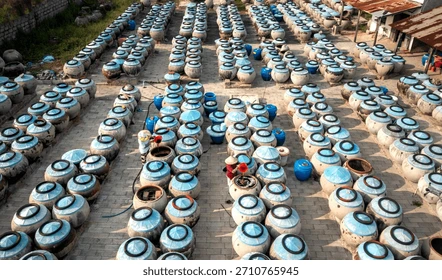
The sun does the work here rather than the shade. Phan Thiet fish sauce, made on the coast of what is now Lam Dong, is fermented in open wooden vats under direct sun in one of the hottest, driest and windiest parts of Vietnam — which is why it ferments faster and tastes different from sauce made in the north. It is one of the country's two most famous fish sauce origins and it carries a protected geographical indication, like the highland produce of Da Lat. So what should you buy?
The trade here is centuries old and the city grew around it before tourism existed, which is why the vats sit inside the urban area rather than outside it.
How it is made
Anchovy caught off this coast is mixed with salt at a fixed ratio, packed into wooden vats, weighted and left to ferment. The first liquid drawn off is the strongest and most valuable.
The climate is the variable. Strong sun and low humidity here shorten the fermentation compared with the northern producing regions.
Traditional makers still use wooden vats and several will show them to visitors, which is the simplest reassurance available.
Buy a small bottle of a high grade rather than a large one of a low grade. It is the same advice everywhere and it matters most here.
Reading the label
The number that matters is the protein rating, given in degrees. Higher means a stronger first-draw sauce; the lowest grades are heavily diluted.
Read the ingredients as well. Traditional sauce lists anchovy and salt and nothing else; industrial versions add water, sugar, flavour enhancer and preservative.
Producers sell in glass and in plastic, and the glass is worth the extra weight for anything going home with you.
What to look for
Clear reddish-brown colour, transparent when held to the light, and a smell that is savoury rather than sharply ammoniac.
Buy the higher grade rather than the larger bottle. Strong sauce lasts longer because you use less of it.
Wooden vats hold several tonnes each and a producer will usually let you look. Seeing them is the simplest check available.
Not the other famous one
An island province in the south produces the country's other protected fish sauce, and the two are the usual comparison.
That one is fermented in shade over a longer period and is typically milder and rounder. This one is stronger and saltier. Neither is better; they are used differently in their own regions.
Carrying it home
Glass travels better than plastic and does not take on the smell. Ask for it sealed if it is going into checked luggage and double-bag it regardless.
Check the liquid rules for your airline and the import rules at your destination before packing it.
Ask to taste. Producers expect it and one spoonful tells you more than any label or protein number.
Where to buy
Producers in the coastal city sell direct and that is where to go rather than a supermarket shelf — see Mui Ne for the surrounding coast. It is the durable gift from this half of the province; the highland equivalent is artichoke and highland vegetables. The dish it seasons is banh canh cha ca. Era Tourist buys at the vats rather than at a shop.
Ở đây nắng làm việc chứ không phải bóng râm. Nước mắm Phan Thiết, làm trên dải bờ nay thuộc Lâm Đồng, được ủ trong thùng gỗ để ngỏ dưới nắng trực tiếp ở một trong những vùng nóng nhất, khô nhất và nhiều gió nhất Việt Nam — và đó là lý do nó lên men nhanh hơn cùng có vị khác nước mắm làm ở phía bắc. Đây là một trong hai vùng nước mắm nổi tiếng nhất nước và có chỉ dẫn địa lý được bảo hộ, như nông sản vùng cao của Đà Lạt. Vậy nên mua gì?
Nghề này ở đây đã hàng thế kỷ và thành phố lớn lên quanh nó từ trước khi có du lịch, và đó là lý do các nhà thùng nằm ngay trong khu dân cư chứ không nằm ngoài.
Làm thế nào
Cá cơm đánh bắt ngoài khơi dải bờ này được trộn muối theo tỷ lệ cố định, nén vào thùng gỗ, đè vật nặng rồi ủ. Nước rút lần đầu là đậm nhất và quý nhất.
Khí hậu mới là biến số. Nắng gắt và độ ẩm thấp ở đây rút ngắn thời gian ủ so với các vùng làm mắm phía bắc.
Các nhà làm nghề truyền thống vẫn dùng thùng gỗ và nhiều nơi cho khách xem, đó là lời bảo đảm đơn giản nhất có được.
Hãy mua một chai nhỏ hạng cao thay vì chai lớn hạng thấp. Lời khuyên ấy đúng ở mọi nơi và đúng nhất ở đây.
Đọc nhãn
Con số đáng kể là độ đạm. Độ càng cao thì càng gần nước mắm nhĩ; các hạng thấp nhất đã pha loãng rất nhiều.
Hãy đọc cả thành phần. Nước mắm truyền thống ghi cá cơm và muối, không gì khác; bản công nghiệp thêm nước, đường, chất điều vị và chất bảo quản
Nhà thùng bán cả chai thủy tinh lẫn chai nhựa, và thủy tinh đáng để chịu thêm chút nặng cho thứ sẽ theo bạn về nhà.
Nhìn gì để chọn
Màu nâu đỏ trong, soi lên ánh sáng thì trong suốt, và mùi đậm đà chứ không khai gắt.
Hãy mua hạng cao hơn thay vì chai lớn hơn. Mắm đậm dùng được lâu hơn vì mỗi lần chỉ cần ít.
Mỗi thùng gỗ chứa vài tấn và nhà thùng thường cho khách vào xem. Nhìn thấy chúng là phép kiểm đơn giản nhất có được.
Không phải vùng mắm nổi tiếng kia
Một tỉnh đảo phía nam làm ra loại nước mắm được bảo hộ còn lại của cả nước, và hai bên là cặp so sánh quen thuộc.
Bên kia ủ trong bóng râm suốt thời gian dài hơn và thường dịu cùng tròn vị hơn. Bên này đậm và mặn hơn. Không bên nào hơn bên nào; chúng được dùng khác nhau ở vùng của mình.
Mang về nhà
Thủy tinh đi đường tốt hơn nhựa và không bị ám mùi. Hãy xin niêm kín nếu chai đi hành lý ký gửi và dù sao cũng nên bọc hai lớp túi.
Hãy kiểm tra quy định chất lỏng của hãng bay và quy định nhập cảnh ở nơi bạn đến trước khi xếp vào vali.
Hãy xin nếm thử. Nhà thùng vẫn lường trước chuyện đó và một thìa nói lên nhiều hơn mọi cái nhãn hay con số độ đạm.
Mua ở đâu
Các nhà thùng trong thành phố ven biển bán trực tiếp và đó là nơi nên tới thay vì kệ siêu thị — xem Mũi Né để biết dải bờ quanh đó. Đây là món quà bền của nửa tỉnh này; thứ tương đương ở cao nguyên là atiso và rau Đà Lạt. Món ăn mà nó nêm là bánh canh chả cá. Era Tourist mua tại nhà thùng chứ không mua ở cửa hàng.