
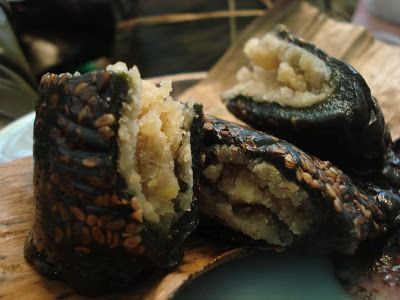
The cake is black, and that is not a flaw. Banh gai Tu Tru is made in a village in Tho Xuan district in Thanh Hoa from glutinous rice flour blended with the boiled leaf of the ramie plant, which turns the dough almost black and gives it a faint grassy sweetness. It has been made here for generations and it was historically offered at the ancestral shrines of the dynasty that came from this district. So what should you look for?
The dough is steamed rather than baked, which is why the finished cake is soft and slightly tacky rather than firm.
What is in it
Glutinous rice flour, molasses, and ramie leaf boiled and pounded to a paste, wrapped around a filling of mung bean, coconut, pork fat and sometimes lotus seed, then steamed in dried banana leaf.
The pork fat is traditional and it is what stops the filling drying out. Versions made without it are lighter and considerably less interesting.
The cakes are small and dense and one is enough with tea. They are sold in bundles of five or ten tied with string.
Why it is black
The leaf is boiled until soft, squeezed and pounded into the dough. That is the whole reason for the colour, and a cake that is merely dark brown has used less of it.
The flavour it adds is subtle rather than strong: slightly grassy, slightly bitter, and it balances the sweetness of the molasses.
Ramie is grown locally for the leaf, so the supply and the making village have always sat in the same district.
How to judge one
The dough should be genuinely black, soft and slightly sticky, and the cake should feel dense in the hand. The filling should be moist rather than crumbly.
Dried banana leaf rather than fresh is correct here. It is what gives the finished cake its particular scent.
Eat one warm if the workshop offers it. Straight from the steamer is a different cake from one that has cooled in a bag.
Keeping it
It keeps for several days at room temperature and longer chilled, and it steams back to softness easily if it has hardened.
It travels well, which is why it became a standard gift long before anyone thought about tourism.
Similar cakes are made elsewhere in the north and the names overlap, so ask for the village by name rather than the type.
It is eaten with green tea, and the bitterness of strong tea against the molasses is the whole reason the pairing stuck.
Where it comes from
The making village lies in the same district as the province's great dynastic site, and buying it there rather than in the city is both cheaper and fresher.
Workshops sell direct along the road, and several will let you see the steaming baskets.
Where it fits
Buy it on the same trip as Lam Kinh, which sits in the same district, and you have covered the district's history and its sweet in one drive. In the capital it is sold everywhere; see Thanh Hoa Market. It is the durable half of the province's gift pairing, the other being nem chua. Eat first; see our shortlist of specialty restaurants. Era Tourist buys these at the workshop on the Lam Kinh drive.
Chiếc bánh màu đen, và đó không phải khuyết điểm. Bánh gai Tứ Trụ được làm ở một làng thuộc huyện Thọ Xuân, Thanh Hóa, từ bột nếp trộn với lá gai luộc nhuyễn, thứ làm vỏ bánh đen gần như tuyệt đối và cho nó vị ngọt thoảng mùi lá. Bánh được làm ở đây qua bao đời và xưa nay vẫn được dâng ở đền miếu của triều đại xuất thân từ chính huyện này. Vậy nên nhìn gì?
Bột được hấp chứ không nướng, và đó là lý do chiếc bánh thành phẩm mềm và hơi dính chứ không đanh.
Trong bánh có gì
Bột nếp, mật mía, và lá gai luộc rồi giã nhuyễn, bọc quanh nhân đậu xanh, dừa, mỡ heo và đôi khi có hạt sen, rồi hấp trong lá chuối khô.
Mỡ heo là phần truyền thống và là thứ giữ cho nhân khỏi khô. Bản làm không có mỡ thì nhẹ hơn và kém thú vị hơn nhiều.
Bánh nhỏ và chắc, một chiếc là đủ khi uống trà. Bánh bán theo bó năm hoặc mười chiếc buộc lạt.
Vì sao bánh đen
Lá gai được luộc mềm, vắt ráo rồi giã vào bột. Đó là toàn bộ lý do của màu sắc, và chiếc bánh chỉ nâu sẫm là đã dùng ít lá hơn.
Vị mà lá mang lại tinh tế chứ không mạnh: thoảng mùi cỏ, thoảng đắng, và nó cân lại vị ngọt của mật mía.
Cây gai được trồng tại chỗ để lấy lá, nên vùng nguyên liệu và làng làm bánh xưa nay vẫn nằm trong cùng một huyện.
Chấm một chiếc thế nào
Vỏ phải đen thật, mềm và hơi dính, và cầm lên phải thấy chắc tay. Nhân phải ẩm chứ không bở vụn.
Lá chuối khô chứ không phải lá tươi mới là đúng ở đây. Chính nó cho chiếc bánh thành phẩm cái mùi đặc trưng
Nếu lò mời thì hãy ăn thử một chiếc lúc còn ấm. Vừa ra khỏi chõ là một chiếc bánh khác hẳn chiếc đã nguội trong túi.
Giữ bánh
Bánh để được vài ngày ở nhiệt độ thường và lâu hơn nếu ướp lạnh, và hấp lại là mềm ra nếu đã cứng.
Bánh đi đường tốt, và đó là lý do nó thành món quà chuẩn mực từ rất lâu trước khi có ai nghĩ tới du lịch.
Các tỉnh phía bắc cũng làm loại bánh tương tự và tên gọi trùng nhau, nên hãy hỏi đích danh tên làng chứ đừng hỏi tên loại bánh.
Bánh ăn với chè xanh, và vị chát của chè đặc đối lại vị mật mía chính là lý do cặp đôi ấy tồn tại tới nay.
Từ đâu ra
Làng làm bánh nằm trong chính huyện có khu di tích triều đại lớn của tỉnh, và mua tại đó vừa rẻ hơn vừa mới hơn mua trong thành phố.
Các lò bán trực tiếp dọc đường, và vài nơi cho khách xem những chõ bánh đang hấp.
Chỗ của nó trong lộ trình
Hãy mua trong cùng chuyến đi Lam Kinh, cùng huyện với nhau, là bạn gói trọn lịch sử và món bánh của huyện ấy trong một chặng lái. Trong tỉnh lỵ thì bánh bán khắp nơi; xem chợ Thanh Hóa. Đây là nửa để lâu được trong cặp quà của tỉnh, nửa kia là nem chua. Ăn trước đã; xem tuyển chọn quán đặc sản. Era Tourist mua bánh tại lò trên chặng đi Lam Kinh.