
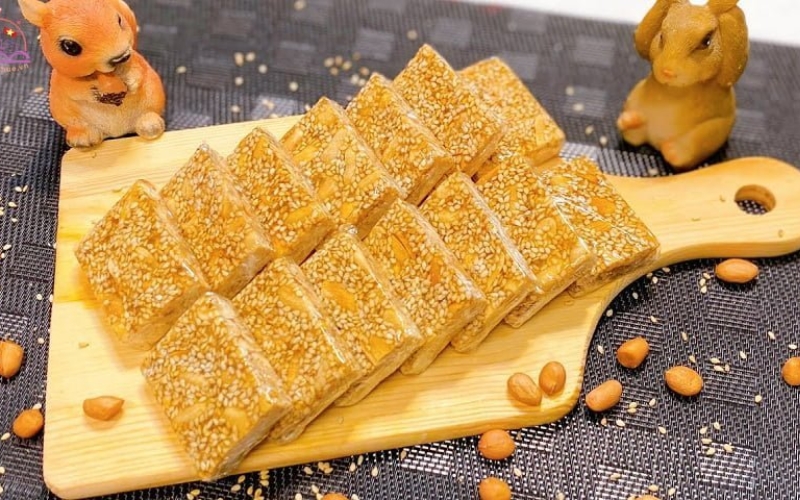
Pick up a piece of Hue sesame candy and bend it. If it folds into a U and springs back without cracking, you are holding the chewy style made properly. If it snaps cleanly, you have the crisp style — also correct, but a different sweet entirely. That single test is how families here have graded me xung for generations, and it is more useful than any label on the box. So which one should go home in your suitcase?
What it is made of
The base is malt sugar cooked down with sugar and a little rice flour until it pulls into a pale, elastic mass. Roasted sesame goes in throughout, crushed peanut into most versions, and the sheet is cut into small squares while still warm.
There is no butter, no dairy and no egg in the traditional recipe, which is why it keeps for weeks at room temperature and why it travels better than almost any other Vietnamese sweet.
Sesame is toasted before it goes in, never raw. It is the step that separates a workshop batch from a factory one, because under-toasted sesame leaves the candy tasting flat no matter how good the malt sugar was.
The two families: chewy and crisp
The chewy version — me xung deo — is the older and more demanding one. It stays soft, pulls slightly against the teeth, and must be wrapped individually in edible rice paper or it will glue itself to the box.
The crisp version layers the same sesame mixture between thin wafer sheets, producing something closer to a brittle. It is easier to make, easier to ship, and far more common in the boxes sold at transport hubs.
How to tell fresh from stale
Fresh chewy candy is matt and pale gold; as it ages it darkens at the edges and the surface turns glassy. The rice paper wrapper should peel away cleanly — if it has fused into the sugar, the box has been sitting through a warm season.
For the crisp style, listen rather than look. A fresh piece breaks with a dry snap; a tired one bends before it breaks because the wafer has taken on humidity.
What it is served with
Locally this is not eaten alone. It goes with green tea or lotus tea, and the pairing is not decorative: the candy is sweet enough that unsweetened tea is what makes a second piece possible. Any Hue household offering guests me xung will produce a pot alongside it.
Green tea is the everyday partner; lotus tea is the one brought out for guests. Neither should be sweetened, and both are served in small cups rather than mugs, so a piece of candy and a cup finish at roughly the same moment.
Buying it as a gift
Longstanding workshops still operate in the city and sell direct, which is where the freshest chewy candy is found; the boxes sold at stations and airports are almost always the crisp style, chosen for shelf life.
Buy chewy candy only if you are flying home within a few days and can keep it out of the heat. For a long trip, or for handing out at an office, the crisp style is the sensible choice. Check that the box is sealed and that individual pieces are wrapped rather than loose.
Where it sits among Hue souvenirs
Me xung is the sweet half of the standard Hue gift pairing; the drinking half is usually Hue royal tea, and the two are frequently sold from the same counter. If you have been eating your way through the city — a morning bowl of bun bo, an evening of grilled skewers — this is the part of the trip that travels home with you. Era Tourist builds a shopping stop into the last afternoon rather than the first, so nothing melts in the boot for three days: see the routing in our Hue destination guide, or extend south to Lang Co Beach.
Cầm một miếng mè xửng lên và bẻ thử. Nếu nó gập lại hình chữ U rồi bật về mà không gãy, bạn đang cầm loại dẻo làm đúng. Nếu nó gãy đánh tách, đó là loại giòn — cũng đúng, nhưng là một món khác hẳn. Chỉ một phép thử ấy thôi là cách người Huế chấm mè xửng qua bao thế hệ, và nó đáng tin hơn mọi dòng chữ trên hộp. Vậy nên mang loại nào về?
Làm từ gì
Cốt là mạch nha thắng cùng đường và chút bột gạo tới khi kéo thành khối dẻo màu nhạt. Mè rang trộn đều trong suốt quá trình, đậu phộng giã cho phần lớn phiên bản, rồi cán thành tấm và cắt vuông lúc còn ấm.
Công thức truyền thống không có bơ, không sữa, không trứng — vì vậy mè xửng để được nhiều tuần ở nhiệt độ thường và đi đường xa tốt hơn gần như mọi món ngọt Việt khác.
Mè phải rang trước khi trộn, không bao giờ để sống. Đây là bước tách một mẻ làm thủ công khỏi một mẻ công nghiệp, vì mè rang non thì kẹo nhạt vị dù mạch nha có ngon tới đâu.
Hai dòng: dẻo và giòn
Bản dẻo là bản cũ hơn và khó hơn. Nó mềm, hơi níu răng, và bắt buộc phải gói từng viên trong bánh tráng mỏng ăn được, nếu không sẽ dính chặt vào hộp.
Bản giòn kẹp cùng hỗn hợp mè ấy giữa hai lớp bánh đa mỏng, cho ra thứ gần với kẹo giòn. Dễ làm hơn, dễ vận chuyển hơn, và là loại phổ biến trong các hộp bán ở bến xe, sân bay.
Nhận biết mới hay cũ
Mè xửng dẻo mới có màu vàng nhạt và bề mặt lì; để lâu thì sẫm dần ở rìa và mặt kẹo bóng lên như thủy tinh. Lớp bánh tráng gói phải bóc ra gọn — nếu nó đã dính quyện vào đường thì hộp đó đã qua một mùa nóng.
Với loại giòn thì nghe thay vì nhìn. Miếng mới gãy khô và đanh; miếng cũ oằn xuống trước khi gãy vì lớp bánh đã ngậm ẩm.
Ăn cùng thứ gì
Ở Huế không ai ăn mè xửng một mình. Nó đi với trà xanh hoặc trà sen, và sự kết hợp ấy không phải để làm cảnh: kẹo đủ ngọt nên chính chén trà không đường mới khiến miếng thứ hai còn ăn nổi. Nhà nào ở Huế mời khách mè xửng cũng kèm một ấm trà.
Trà xanh là bạn đi cùng hằng ngày; trà sen là thứ mang ra khi có khách. Cả hai đều không thêm đường, và đều rót chén nhỏ chứ không dùng ly lớn, để một miếng kẹo và một chén trà kết thúc cùng lúc.
Mua làm quà
Trong thành phố vẫn còn những cơ sở làm nghề lâu năm bán trực tiếp, và đó là nơi tìm được mè xửng dẻo mới nhất; hộp bán ở nhà ga hay sân bay gần như luôn là loại giòn, chọn vì hạn dùng.
Chỉ mua loại dẻo nếu bạn bay về trong vài ngày và giữ được nó tránh nóng. Đi dài ngày, hoặc mua chia cho cả văn phòng, thì loại giòn là lựa chọn hợp lý. Kiểm tra hộp còn niêm và từng viên có gói riêng hay để rời.
Chỗ đứng trong giỏ quà Huế
Mè xửng là nửa phần ngọt của cặp quà Huế kinh điển; nửa còn lại thường là trà cung đình Huế, và hai thứ hay nằm chung một quầy. Nếu cả chuyến bạn đã ăn dọc thành phố — tô bún bò buổi sáng, đĩa nem nướng buổi tối — thì đây là phần của chuyến đi theo bạn về nhà. Era Tourist xếp buổi mua quà vào chiều cuối chứ không phải ngày đầu, để không có gì chảy trong cốp xe suốt ba ngày: xem lộ trình tại cẩm nang điểm đến Huế, hoặc kéo dài về phía nam tới biển Lăng Cô.