
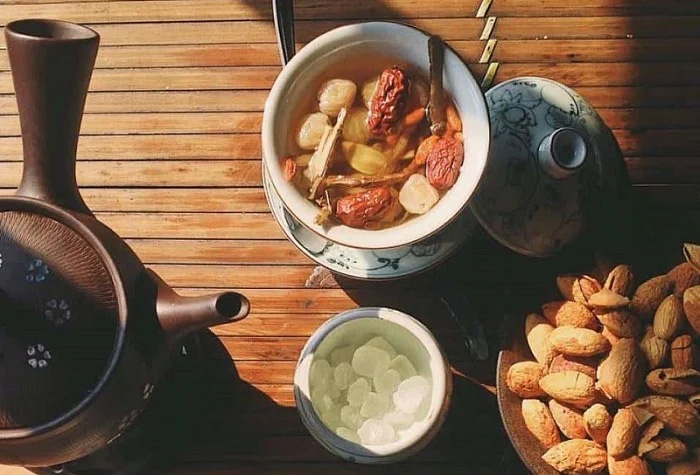
The first thing to understand about Hue royal tea is that it contains no tea. Open a bag and you will find dried chrysanthemum, jujube, lotus seed, liquorice root and a dozen other botanicals — but not a single leaf of Camellia sinensis. That is not a flaw, it is the whole design: this is a caffeine-free evening infusion, which is exactly why it behaves so differently from the green tea sold beside it. So what is actually in the bag, and how do you brew it without ruining it?
A blend, not a leaf
Commercial blends typically run to twelve or sixteen ingredients. Chrysanthemum and jujube give the sweetness, artichoke and liquorice the body, lotus seed and goji the softer background notes, with cassia seed or sophora flower appearing depending on the maker.
Because it is a blend, no two brands taste the same, and the ratio is the recipe. Buying a second bag from a different producer will not reproduce the cup you liked.
Read the ingredient list before buying rather than the front of the box. A blend heavy on chrysanthemum drinks light and floral; one heavy on artichoke drinks darker and slightly bitter, and the two suit very different people.
The name, and what it does and does not mean
The blends are marketed on an association with the Nguyen court, whose physicians did prepare herbal infusions for the palace. The products sold today, however, are modern commercial formulations rather than a single documented court recipe, and claims about provenance vary considerably between producers.
Treat the name as a style, in the same way "royal cuisine" describes a manner of cooking in Hue rather than a fixed menu.
What it is not is a medicine, and nothing here should be treated as one. It is a pleasant, sugar-free hot drink with a long local habit behind it, which is reason enough to carry a bag home.
How to brew it properly
Rinse the blend briefly with hot water and pour that first water away. Then steep in water at roughly 85 to 90 degrees for five to seven minutes, covered.
The mistake almost everyone makes is boiling it hard or leaving it too long. Liquorice is the most assertive ingredient in the mix, and given time it will flatten everything else into a single sweet note. Under-brewed is a much smaller loss than over-brewed.
When Hue drinks it
Because there is no caffeine, this is an evening drink and a hot-weather drink. It is served hot in small cups after dinner, and it is also brewed strong, cooled and kept in the fridge through summer.
It takes no sugar. Anyone adding sugar has usually been given an over-brewed cup and is correcting the wrong problem.
A single portion refills two or three times before it gives out, and the second steep is usually the best one — the first carries the sharpest liquorice, the second the roundest fruit.
Choosing a bag that is worth carrying home
Look for whole recognisable pieces rather than dust: intact chrysanthemum heads, whole jujube, visible lotus seed. Fine broken material brews fast and bitter and is a sign of low-grade filler. The bag should smell dry and floral, never musty.
Packaging matters more than it looks. These are dried botanicals and they absorb humidity quickly, so choose a sealed foil pack over a decorative box with a loose lid, and keep it away from the kitchen once home.
Where it fits in the Hue gift basket
Royal tea is the drinking half of the classic Hue pairing; the sweet half is Hue sesame candy, and an unsweetened cup is what makes a second piece of candy possible. Both sit naturally at the end of a trip that started inside the Imperial City. Era Tourist puts the shopping stop on the final afternoon so nothing spends three days in a warm car — see the routing in our Hue destination guide, or pair the citadel morning with Hue Ancient Citadel.
Điều đầu tiên cần biết về trà cung đình Huế: trong đó không có trà. Mở gói ra bạn sẽ thấy cúc khô, hồng táo, hạt sen, cam thảo và cả chục vị thảo mộc khác — nhưng không một lá chè nào. Đó không phải khiếm khuyết mà là toàn bộ thiết kế: đây là thức uống thảo mộc không caffeine dành cho buổi tối, và chính vì vậy nó vận hành khác hẳn gói trà xanh bày cạnh bên. Vậy trong gói có gì, và pha thế nào để không làm hỏng nó?
Một hỗn hợp, không phải một lá
Các công thức thương mại thường gồm mười hai tới mười sáu vị. Cúc và hồng táo cho vị ngọt, atisô và cam thảo cho hậu vị dày, hạt sen và kỷ tử làm nền dịu, còn thảo quyết minh hay hoa hòe thì tùy nhà pha.
Vì là hỗn hợp nên không hãng nào giống hãng nào, và tỷ lệ chính là công thức. Mua gói thứ hai của nhà khác sẽ không cho lại đúng chén bạn từng thích.
Hãy đọc bảng thành phần trước khi mua thay vì đọc mặt hộp. Công thức nhiều cúc thì uống nhẹ và thơm hoa; công thức nhiều atisô thì uống sẫm và hơi đắng — hai kiểu hợp với hai người rất khác nhau.
Cái tên nói gì và không nói gì
Sản phẩm được tiếp thị gắn với triều Nguyễn, nơi thái y viện quả thật có sắc các thang thảo mộc cho hoàng cung. Tuy nhiên, thứ bán hôm nay là công thức thương mại hiện đại chứ không phải một toa cung đình được ghi chép thống nhất, và cách các nhà sản xuất diễn giải nguồn gốc rất khác nhau.
Nên hiểu cái tên như một phong cách, giống như "ẩm thực cung đình" mô tả một lối nấu của Huế chứ không phải một thực đơn cố định.
Thứ nó không phải là: một vị thuốc. Không nên coi bất kỳ thành phần nào ở đây như thuốc. Đây là một thức uống nóng dễ chịu, không đường, có thói quen dùng lâu đời của người địa phương — chừng đó đã đủ lý do để mang một gói về.
Pha thế nào cho đúng
Tráng nhanh bằng nước nóng rồi đổ bỏ nước đầu. Sau đó hãm ở khoảng 85–90 độ trong năm tới bảy phút, có đậy nắp.
Lỗi gần như ai cũng mắc là đun sôi già hoặc hãm quá lâu. Cam thảo là vị mạnh nhất trong hỗn hợp, để lâu là nó san phẳng mọi vị khác thành một tầng ngọt duy nhất. Hãm non thiệt ít hơn hãm già rất nhiều.
Người Huế uống lúc nào
Vì không caffeine, đây là thức uống buổi tối và thức uống mùa nóng. Nó được rót nóng trong chén nhỏ sau bữa ăn, và cũng thường hãm đặc, để nguội rồi cất tủ lạnh uống suốt mùa hè.
Không thêm đường. Ai phải thêm đường thường là vì đã nhận một chén hãm quá tay và đang sửa nhầm chỗ.
Một phần hãm được hai tới ba nước mới hết vị, và nước thứ hai thường ngon nhất — nước đầu gắt cam thảo, nước hai mới tròn vị trái cây.
Chọn gói đáng mang về
Hãy tìm nguyên liệu còn nguyên hình nhận ra được thay vì vụn: bông cúc còn nguyên, táo còn nguyên trái, hạt sen nhìn rõ. Vụn nát thì ra nhanh và đắng, dấu hiệu của hàng độn kém. Gói phải có mùi khô và thơm hoa, tuyệt đối không hắc mùi ẩm mốc.
Bao bì quan trọng hơn vẻ ngoài của nó. Đây là thảo mộc khô, hút ẩm rất nhanh, nên chọn túi thiếc hàn kín thay vì hộp trang trí nắp lỏng, và về nhà thì để xa bếp.
Chỗ đứng trong giỏ quà Huế
Trà cung đình là nửa phần uống của cặp quà Huế kinh điển; nửa ngọt là mè xửng Huế, và chính chén trà không đường mới khiến miếng kẹo thứ hai còn ăn nổi. Cả hai nằm rất tự nhiên ở cuối một chuyến đi khởi đầu trong Đại Nội Huế. Era Tourist đặt buổi mua quà vào chiều cuối để không món nào nằm ba ngày trong xe nóng — xem lộ trình tại cẩm nang điểm đến Huế, hoặc ghép buổi sáng thành cổ với Kinh thành Huế.