
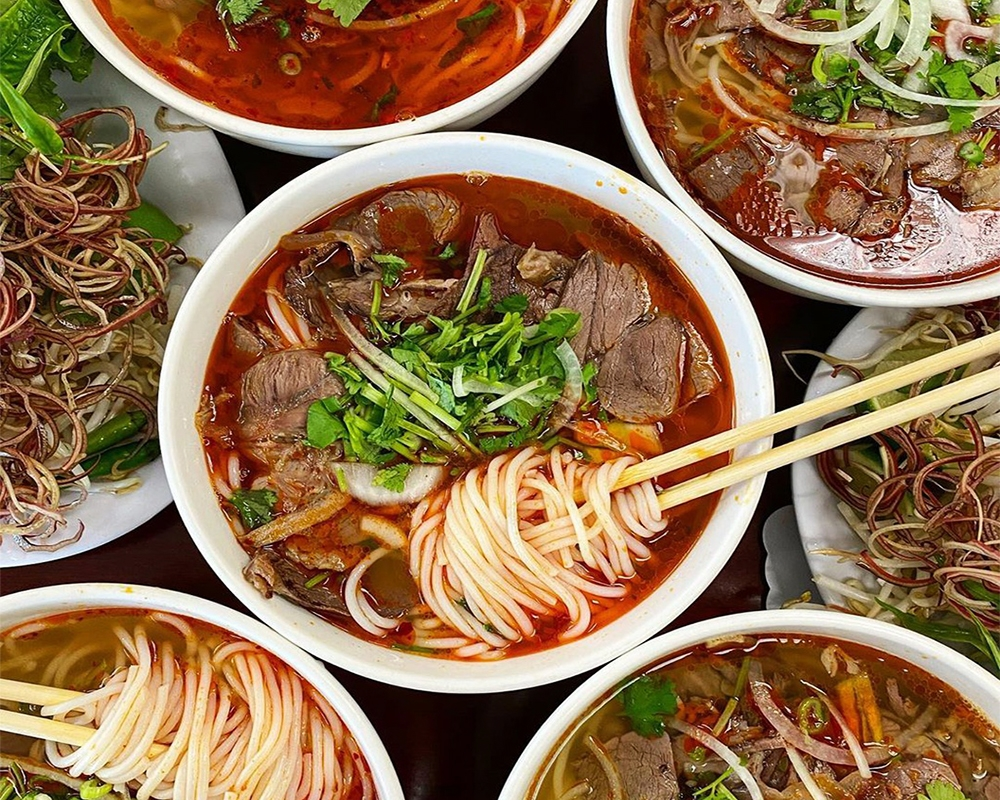
Ask for "bun bo Hue" inside Hue itself and you have already marked yourself as a visitor. Here the dish is simply bun bo — the city does not need to sign its own work. What arrives is a bowl built on beef shank, pork knuckle and lemongrass, sharpened by a spoonful of fermented shrimp paste that most first-timers never notice and no cook here would leave out. So what separates a real Hue bowl from the versions sold everywhere else in Vietnam?
The ingredient that makes it Hue
The broth begins conventionally — bones simmered for hours with lemongrass stalks bruised and dropped in whole. What changes everything is mam ruoc, fermented shrimp paste, dissolved in water, left to settle and then poured off clear into the pot. The sediment is discarded; only the perfumed liquid goes in.
Done well it is invisible. It gives the broth a savoury depth that no amount of bone or salt can imitate, and it is the reason a bowl in Hue tastes rounder than the sweeter, chilli-heavy interpretations served in the south.
Noodles, and why they are round
The noodle is a thick round rice strand, closer to a spaghetti than to the flat pho noodle. It has to be, because this broth is heavy — a flat noodle would collapse under it. Locals judge a shop partly on whether the noodles arrive with any bite left.
Shops buy the strands fresh each morning from noodle makers who deliver by motorbike; nothing here is dried. That is also why a bowl ordered at four in the afternoon is a different dish from the same bowl at six in the morning.
What is actually in the bowl
A full order carries beef shank sliced across the grain, a section of pork knuckle with the skin on, a slab of cubed congealed pork blood, and a quenelle of crab-and-pork paste. Beyond that the bowl is unadorned: no bean sprout mountain, no fistful of herbs.
Greens arrive separately and stay modest — shredded banana flower, sliced cabbage, a few sprigs of Vietnamese coriander. The restraint is deliberate. In Hue the broth is the argument; everything else is punctuation.
The crab-and-pork quenelle is the one component that varies most between shops, since each kitchen mixes its own ratio and some skip it entirely. It is a fair shorthand for how much care a place takes.
It is a breakfast, not a dinner
The best bowls in the city are gone by nine in the morning. Hue eats bun bo at breakfast, standing or sitting at low tables on the pavement, often before seven. Shops that open at midday are usually serving visitors, and the difference in broth — first pot of the day versus fourth top-up — is real.
If your schedule only allows a late bowl, choose a shop that clearly closes early rather than one that runs all day.
Ordering it the way locals do
The plate on the table holds lime, sliced chilli, and a saucer of chilli-and-shrimp sauce. Add the sauce a little at a time; it is strong, and the broth is already seasoned. Salt is never added.
The one instruction worth learning: if you want the bowl without the congealed blood, say so when ordering rather than pushing it aside afterwards — kitchens portion the bowl before it leaves the pot.
Where it fits in a Hue day
A bowl of bun bo before the heat arrives, then the walled city as it opens, is the standard Hue morning — see the Imperial City for what follows. In the afternoon, when appetite returns, the city switches to lighter street bowls such as Nam Pho thick noodle soup. Era Tourist builds Hue itineraries around that rhythm — food early, monuments before noon, river late. Start planning with our Hue destination guide, or extend the trip toward the coast at Lang Co Beach.
Vào tới Huế mà gọi "bún bò Huế" là tự nhận mình khách phương xa. Ở đây người ta chỉ nói bún bò — thành phố không cần ký tên lên món của chính mình. Tô bún dọn ra dựng trên nạm bò, giò heo và sả, được đánh thức bằng một muôi ruốc mà phần lớn người ăn lần đầu không nhận ra, còn không đầu bếp Huế nào chịu bỏ. Vậy điều gì tách một tô bún bò Huế thật khỏi những phiên bản bán khắp nơi?
Thứ làm nên chất Huế
Nước dùng bắt đầu rất thường: xương hầm nhiều giờ, sả đập dập thả nguyên cây. Thứ làm đổi cục diện là ruốc — mắm ruốc hòa nước, để lắng, chắt lấy phần nước trong đổ vào nồi. Phần cặn bỏ đi, chỉ phần nước thơm được dùng.
Làm khéo thì ruốc vô hình. Nó cho nước dùng một chiều sâu đậm đà mà xương hay muối không thay thế được, và đó là lý do tô bún ở Huế tròn vị hơn hẳn các phiên bản ngọt và nặng ớt ở phương Nam.
Sợi bún và vì sao phải tròn
Sợi bún ở đây to, tròn, gần với sợi spaghetti hơn là sợi phở dẹp. Phải vậy, vì nước dùng này nặng — sợi dẹp sẽ bở ra trong tô. Người Huế chấm điểm một quán một phần ở chỗ bún bưng ra còn dai hay đã nhũn.
Quán lấy bún tươi từ lò giao bằng xe máy mỗi sáng; ở đây không có bún khô. Đó cũng là lý do tô bún lúc bốn giờ chiều là một món khác hẳn tô bún sáu giờ sáng.
Trong tô có gì
Một tô đầy đủ gồm nạm bò thái ngang thớ, một khoanh giò heo còn da, một miếng huyết cắt vuông và một viên chả cua quết. Ngoài ra tô rất gọn: không núi giá, không nắm rau thơm đổ tràn.
Rau dọn riêng và cũng chừng mực — bắp chuối bào, bắp cải xắt, vài nhánh rau răm. Sự tiết chế đó là cố ý. Ở Huế, nước dùng mới là lập luận chính; những thứ còn lại chỉ là dấu câu.
Viên chả cua là thành phần chênh lệch nhiều nhất giữa các quán, vì mỗi bếp tự quết theo tỷ lệ riêng, có nơi bỏ hẳn. Nhìn viên chả cũng đoán được quán chăm tay tới đâu.
Là món điểm tâm, không phải món tối
Những tô ngon nhất thành phố thường hết trước chín giờ sáng. Người Huế ăn bún bò vào buổi sáng, ngồi ghế thấp bên hè, nhiều khi trước bảy giờ. Quán mở lúc trưa thường là quán phục vụ khách, và khác biệt giữa nồi nước đầu ngày với nồi châm lần thứ tư là có thật.
Nếu lịch trình chỉ cho phép ăn muộn, hãy chọn quán đóng cửa sớm thay vì quán bán cả ngày.
Gọi món như người bản địa
Đĩa trên bàn có chanh, ớt xắt và chén sa tế ruốc. Cho sa tế từng chút một; nó rất mạnh, mà nước dùng thì đã đủ vị. Không ai thêm muối.
Một câu đáng học: nếu không ăn huyết, hãy nói ngay lúc gọi thay vì gạt ra sau — bếp chia tô ngay từ nồi.
Chỗ của nó trong một ngày ở Huế
Một tô bún bò trước khi nắng lên, rồi vào Kinh thành lúc vừa mở cổng — đó là buổi sáng chuẩn của Huế; xem tiếp Đại Nội Huế. Đến chiều, khi bụng đói trở lại, thành phố chuyển sang những tô nhẹ hơn như bánh canh Nam Phổ. Era Tourist dựng lịch trình Huế theo đúng nhịp đó — ăn sớm, di tích trước trưa, sông nước lúc chiều. Bắt đầu từ cẩm nang điểm đến Huế, hoặc nối dài chuyến đi ra biển Lăng Cô.