
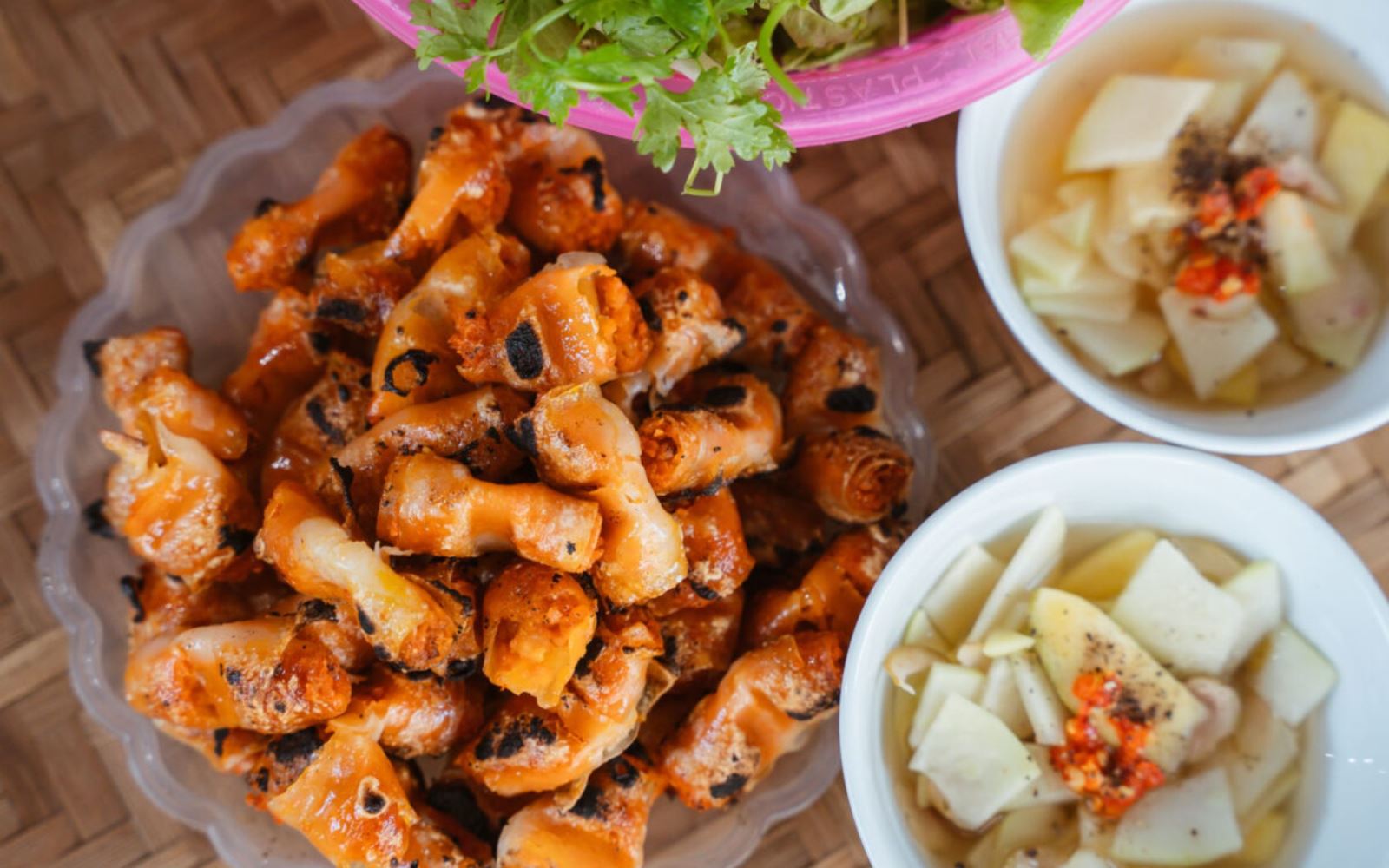
The wrapper is a noodle sheet, not rice paper. Cha tom takes shrimp pounded with pork belly and shallot, rolls it inside a thin sheet of the same fresh rice noodle used for pho, threads the rolls onto skewers and grills them over charcoal until the outside blisters. It is the dish Thanh Hoa city eats in the evening and it is almost impossible to find outside the province. So what makes a good skewer?
It is a city dish rather than a village one, and it belongs specifically to the provincial capital rather than to the province as a whole.
What is inside
Shrimp pounded rather than minced, mixed with pork belly for fat, fried shallot for sweetness, and seasoned with pepper and fish sauce. Some kitchens add a little tomato paste, which is what gives the filling its reddish colour.
Pounding rather than mincing keeps some texture in the shrimp. A filling that is completely smooth has been through a machine.
Shrimp from the estuaries rather than farmed stock are the traditional choice, and they are smaller and sweeter.
Ten skewers between two people is a normal order and costs very little. Nobody here treats it as a special-occasion dish.
The wrapper
Fresh rice noodle sheet is cut into squares and rolled around the filling. It is soft going onto the fire and crisps unevenly, which is exactly the point.
Rice paper is not a substitute and shops that use it are making something else.
The rolls are assembled the same day and grilled continuously through the evening, which is why a busy shop is a better bet than a quiet one.
The smell reaches the street before the food reaches the table, which is how most people choose a shop in the first place.
The grill
Skewers go over charcoal and are turned constantly. The outside should be blistered and gold in patches rather than uniformly browned, and the roll should still be soft inside.
They are grilled to order. A tray of skewers sitting under a lamp is not the dish.
Charcoal matters. Rolls done over gas taste noticeably flatter and locals will say so without being asked.
Order it fresh from the fire rather than from a warming tray. A skewer that has been standing loses the contrast between the crisp outside and the soft roll within, which is the entire dish.
How it is eaten
Wrapped in lettuce and herbs with a slice of green banana or pickled vegetable, then dipped in a sweet-sour sauce with chilli and garlic.
Order by the skewer rather than the plate, and order more as you go. Ten between two people is normal.
The dipping sauce differs from shop to shop and changes the dish more than the filling does. It is worth paying attention to.
Vegetables are not optional. The plate of lettuce and herbs is doing structural work against the fat and the char.
When to eat it
Late afternoon and evening. This is a sitting-outside dish eaten slowly with drinks rather than a quick meal.
It is cheap by any standard and the portions are small, which is why nobody here orders it once.
Portions are small on purpose, so a table orders in rounds rather than all at once. Nobody expects a fixed serving.
Where to eat it
The provincial capital is where the concentration is — see our shortlist of specialty restaurants for addresses. Order it alongside the province's famous fermented pork, nem chua, which most of the same shops sell. For the coastal dish instead, see goi ca nhech, and for gifts see Thanh Hoa Market. Era Tourist books the first evening in the city around this grill.
Lớp vỏ là lá bánh phở chứ không phải bánh tráng. Chả tôm lấy tôm giã cùng thịt ba chỉ và hành khô, cuốn trong một lá bánh phở mỏng đúng loại dùng cho phở, xiên que rồi nướng trên than hoa tới khi mặt ngoài rộp lên. Đây là món mà thành phố Thanh Hóa ăn vào buổi tối và gần như không thể tìm thấy ngoài phạm vi tỉnh. Vậy một xiên ngon khác ở đâu?
Đây là món của thành phố chứ không phải của làng, và nó thuộc riêng về tỉnh lỵ chứ không thuộc về cả tỉnh.
Bên trong có gì
Tôm giã chứ không xay, trộn với thịt ba chỉ cho béo, hành phi cho ngọt, nêm tiêu và nước mắm. Vài bếp cho thêm chút bột cà chua, và đó là thứ cho nhân màu đỏ hồng.
Giã thay vì xay giữ lại được chút thớ của con tôm. Nhân nào mịn lì là đã qua máy.
Tôm cửa sông chứ không phải tôm nuôi mới là lựa chọn truyền thống, và chúng nhỏ hơn, ngọt hơn.
Mười xiên cho hai người là đơn bình thường và rất rẻ. Ở đây chẳng ai coi nó là món của dịp đặc biệt.
Lớp vỏ
Lá bánh phở tươi được cắt vuông rồi cuốn quanh nhân. Nó mềm khi lên lửa và giòn không đều, và đó đúng là điều người ta muốn.
Bánh tráng không thay thế được, và quán nào dùng bánh tráng là đang làm một món khác.
Cuốn được làm trong ngày và nướng liên tục suốt buổi tối, và đó là lý do quán đông đáng tin hơn quán vắng.
Mùi thơm ra tới mặt đường trước khi đồ ăn lên bàn, và phần lớn người ta chọn quán đúng bằng cách đó.
Bếp than
Xiên đặt trên than hoa và trở liên tục. Mặt ngoài phải rộp và vàng thành từng vệt chứ không nâu đều, còn bên trong cuốn vẫn phải mềm.
Chả nướng theo yêu cầu. Một khay xiên nằm sẵn dưới ngọn đèn thì không phải món này.
Than hoa có vai trò thật. Cuốn nướng bếp gas ăn nhạt hơn thấy rõ, và người bản địa sẽ nói ra mà chẳng cần ai hỏi.
Hãy gọi xiên vừa ra khỏi lửa chứ đừng lấy từ khay giữ nóng. Xiên để lâu mất đi sự tương phản giữa lớp vỏ giòn và cuốn bánh mềm bên trong, mà đó chính là toàn bộ món ăn.
Ăn thế nào
Cuốn trong xà lách và rau thơm cùng một lát chuối chát hoặc dưa góp, rồi chấm nước mắm chua ngọt có ớt và tỏi.
Hãy gọi theo xiên chứ đừng gọi theo đĩa, và ăn tới đâu gọi thêm tới đó. Mười xiên cho hai người là bình thường.
Nước chấm mỗi quán một khác và nó đổi món ăn nhiều hơn cả phần nhân. Rất đáng để ý.
Rau không phải thứ tùy chọn. Đĩa xà lách và rau thơm đang làm nhiệm vụ cân lại vị béo và vị cháy.
Ăn vào lúc nào
Xế chiều và buổi tối. Đây là món ngồi ngoài trời ăn chậm cùng đồ uống chứ không phải bữa ăn nhanh.
Giá rẻ theo mọi thước đo và suất thì nhỏ, đó là lý do ở đây chẳng ai gọi một lần rồi thôi
Suất nhỏ là có chủ ý, nên cả bàn gọi theo lượt chứ không gọi hết một lần. Ở đây không ai áp suất cố định.
Ăn ở đâu
Tỉnh lỵ là nơi tập trung nhiều nhất — xem tuyển chọn quán đặc sản để có địa chỉ. Hãy gọi kèm món nem lên men trứ danh của tỉnh là nem chua, mà phần lớn các quán ấy đều bán. Muốn món của vùng biển thì xem gỏi cá nhệch, còn mua quà thì xem chợ Thanh Hóa. Era Tourist đặt buổi tối đầu tiên trong thành phố quanh bếp than này.