
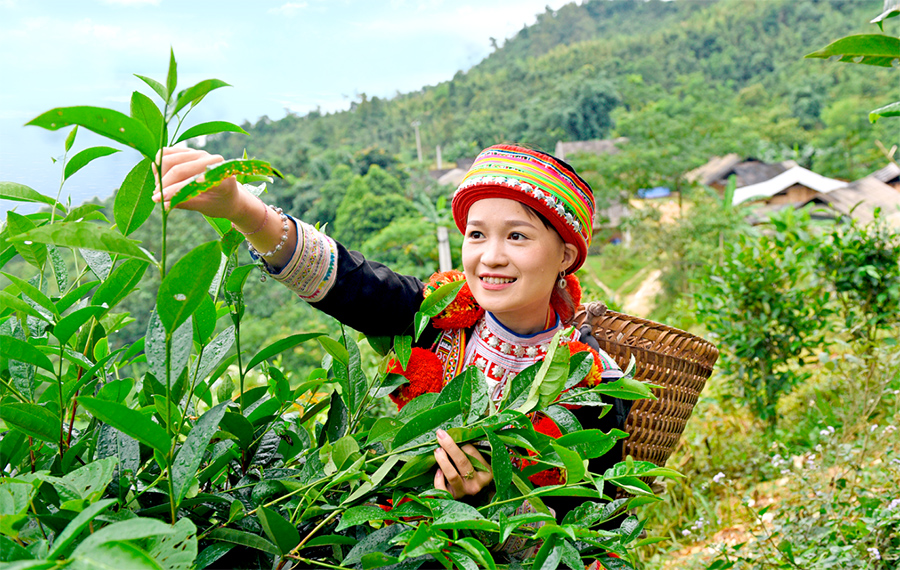
The pickers climb the trees. Shan tuyet tea in the northern districts of the southern half of Tuyen Quang grows on old trees rather than on clipped bushes, some of them centuries old and several metres tall, and harvesting means going up into the branches. The name means snow tea, for the white down on the young buds. It is one of the few Vietnamese teas with a genuine claim to being different. So what should you buy?
Old-tree tea grows across several northern provinces and the name is used broadly. Ask for the district if you want the local version rather than a general one.
What makes it different
The plant is a large-leaf tea variety that grows as a tree at altitude, in cool, misty conditions, with a long slow growing season.
Buds carry a dense white down that gives the tea its name and is visible in dry leaf. The leaves are large and irregular rather than uniform.
Trees are old, often unimproved, and are not fertilised or sprayed in the way plantation tea is. That is a real difference rather than a marketing line.
Some trees in these districts are recognised as heritage trees and are hundreds of years old, which is a claim that can be checked rather than a marketing line.
What it tastes like
Thick, slightly smoky, with a bitterness that turns sweet after swallowing. It stands up to many infusions and the later ones are often the best.
It is not a delicate tea. Drinkers used to plantation green tea usually find it stronger and rougher at first.
Picking happens several times a year and the spring flush is the most prized. Ask which picking you are being sold.
How to judge it
Look for visible white down on the buds, large irregular leaves rather than uniform small ones, and a dry leaf that smells of smoke and hay rather than of nothing.
Ask which district and which village. Producers who process their own can answer; resellers cannot.
Processing is done by hand in small batches, so quality varies between producers far more than it does with plantation tea.
The forms it comes in
Green is the most common. Some producers now make white and black versions from the same leaf, and a few press cakes for ageing.
Start with green. If you like it, the aged versions are worth exploring but they are a different proposition.
Buy a small amount of the best grade rather than a large amount of the cheapest. Good tea is used sparingly.
Brewing it
Use water below boiling and a short first infusion, then extend. Boiling water on old-tree tea brings out the roughness rather than the sweetness.
Rinse the leaf briefly first. It is standard practice here and it improves the second cup considerably.
Sealed foil bags travel best. Loose tea in paper picks up smells from everything else in a bag.
Where to buy
Cooperatives in the tea districts sell direct, on the road toward the lake — see Na Hang Lake and Lam Binh. It is the lightest gift from this half of the province; the other is Ham Yen orange, which is seasonal. Eat in the capital afterwards; see our shortlist of restaurants. See the Tan Trao destination guide for routing. Era Tourist buys tea at a cooperative rather than a roadside stall.
Người hái phải trèo lên cây. Chè Shan tuyết ở các huyện phía bắc của nửa nam Tuyên Quang mọc trên cây cổ thụ chứ không phải bụi chè cắt tỉa, nhiều cây hàng trăm tuổi và cao vài mét, và hái chè nghĩa là leo lên cành. Cái tên nghĩa là chè tuyết, do lớp lông trắng phủ trên búp non. Đây là một trong số ít loại chè Việt Nam có lý do thật để nói mình khác biệt. Vậy nên mua gì?
Chè cây cổ thụ mọc ở nhiều tỉnh phía bắc và cái tên được dùng rộng. Hãy hỏi tên huyện nếu bạn muốn bản bản địa chứ không phải một thứ chung chung.
Khác ở chỗ nào
Giống chè lá to mọc thành cây trên độ cao, trong điều kiện mát và nhiều sương, với mùa sinh trưởng dài và chậm.
Búp phủ một lớp lông trắng dày cho chè cái tên của nó và nhìn thấy được ngay trên lá khô. Lá to và không đều chứ không đồng dạng.
Cây già, phần lớn chưa qua cải tạo giống, và không được bón phun như chè đồn điền. Đó là khác biệt thật chứ không phải một câu quảng cáo.
Vài cây chè trong các huyện này được công nhận là cây di sản và đã hàng trăm tuổi, một khẳng định kiểm chứng được chứ không phải một câu quảng cáo.
Vị ra sao
Đậm, thoảng khói, với vị chát chuyển ngọt hậu sau khi nuốt. Chè chịu được nhiều nước và những nước sau thường mới là nước ngon.
Đây không phải loại chè thanh mảnh. Người quen uống chè xanh đồn điền thường thấy nó mạnh và thô hơn trong lần đầu.
Hái nhiều lứa trong năm và lứa xuân được chuộng nhất. Hãy hỏi mình đang được bán lứa nào.
Chấm thế nào
Hãy tìm lớp lông trắng thấy rõ trên búp, lá to không đều chứ không nhỏ đồng dạng, và lá khô có mùi khói cùng mùi cỏ khô chứ không phải không mùi gì.
Hãy hỏi huyện nào và thôn nào. Người tự chế biến thì trả lời được; người bán lại thì không
Chế biến làm thủ công theo mẻ nhỏ, nên chất lượng chênh giữa các cơ sở nhiều hơn hẳn so với chè đồn điền.
Có những dạng nào
Chè xanh là phổ biến nhất. Vài cơ sở nay làm cả bạch trà và hồng trà từ cùng loại lá, và một số ép bánh để ủ lâu.
Hãy bắt đầu từ chè xanh. Nếu hợp thì các bản ủ lâu đáng khám phá, nhưng đó là một câu chuyện khác.
Hãy mua ít hạng ngon nhất thay vì mua nhiều hạng rẻ nhất. Chè ngon thì dùng dè.
Pha thế nào
Dùng nước dưới điểm sôi và nước đầu ngâm ngắn, rồi kéo dài dần. Nước sôi già dội lên chè cây cổ thụ chỉ làm bật cái thô chứ không bật vị ngọt.
Hãy tráng lá qua một lượt trước. Đó là cách làm chuẩn ở đây và nó cải thiện chén thứ hai rất nhiều.
Túi bạc hàn kín đi đường tốt nhất. Chè rời gói giấy sẽ hút mùi của mọi thứ khác trong hành lý.
Mua ở đâu
Các hợp tác xã ở vùng chè bán trực tiếp, trên đường hướng lên hồ — xem hồ Na Hang và Lâm Bình. Đây là món quà nhẹ nhất của nửa tỉnh này; món còn lại là cam sành Hàm Yên, vốn theo mùa. Ăn ở tỉnh lỵ sau đó; xem tuyển chọn quán ăn. Xem cẩm nang điểm đến Tân Trào để nắm lộ trình. Era Tourist mua chè ở hợp tác xã chứ không mua ở sạp ven đường.