
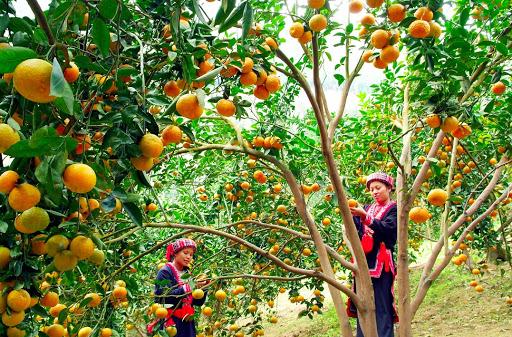
The skin is rough, thick and dark green even when the fruit is ripe. Ham Yen orange from the district of that name in Tuyen Quang is a king mandarin rather than a sweet orange, and it looks nothing like the smooth orange fruit most visitors expect — which is exactly why it is worth explaining before you buy. It carries a protected geographical indication and it is the province's best-known agricultural product. So what should you know?
The district has built the name into a recognised brand with packaging and traceability, which is unusual for Vietnamese fruit and useful for a buyer.
What it actually is
It is a king mandarin, a natural cross between mandarin and pomelo, with a loose rough rind and segments that separate cleanly.
The rind stays green or turns only partly yellow at ripeness, which trips up buyers who judge citrus by colour. Green skin here does not mean unripe.
The flesh is deep orange, very juicy, and balanced between sweet and tart rather than simply sweet.
The district sits on the main road north from the capital, so buying at source needs no detour at all if you are heading toward the lakes.
Not the other oranges
Two other named Vietnamese oranges come from provinces to the south and are different fruit with different growing areas. The names are used loosely by sellers.
If a seller cannot say which district the fruit came from, they are selling something general rather than this.
Orchards run along the hillsides on both sides of the main road through the district, so seeing where the fruit comes from requires no detour at all.
The season
Harvest runs through the cold months from late autumn into the lunar new year, and the fruit is at its best in the middle of that window.
Outside the season what is on sale locally has come from elsewhere or from storage.
Prices climb in the fortnight before the lunar new year when the whole region buys at once. Buying a little earlier is noticeably cheaper.
Buying it
Orchards along the main road in the growing district sell direct in season, which is cheaper and more certain than a general stall.
Heavy for its size, rind slightly loose but not soft, and no soft patches. Treat unusually cheap fruit as the answer rather than a bargain.
Ask to taste a segment before buying a quantity. Sellers expect it and one taste settles the question faster than any description.
Carrying it home
The thick rind protects the flesh and whole fruit keeps a couple of weeks in a cool place, which makes it one of the more transportable fresh gifts.
Do not pack it in soft luggage, and check the import rules for fresh produce at your destination.
Where it fits
The growing district sits on the road running north from the capital toward the lakes — see Na Hang Lake and Lam Binh — so an orchard stop fits naturally into that drive. The year-round alternative from the same half of the province is Shan tuyet tea. Eat in the capital before setting out; see our shortlist of restaurants. See the Tan Trao destination guide for routing. Era Tourist only schedules orchard stops when the fruit is on the tree.
Vỏ sần, dày và vẫn xanh sẫm ngay cả khi quả đã chín. Cam sành Hàm Yên từ huyện cùng tên ở Tuyên Quang là giống cam sành chứ không phải cam ngọt, và nó chẳng giống chút nào thứ quả cam vỏ nhẵn mà phần lớn du khách hình dung — đúng vì thế mà nó đáng được giải thích trước khi bạn mua. Quả có chỉ dẫn địa lý được bảo hộ và là nông sản nổi tiếng nhất của tỉnh. Vậy cần biết gì?
Huyện đã dựng cái tên thành một thương hiệu được công nhận với bao bì và truy xuất nguồn gốc, chuyện hiếm với trái cây Việt và hữu ích cho người mua.
Nó thực sự là giống gì
Đây là cam sành, một dạng lai tự nhiên giữa quýt và bưởi, vỏ sần và lỏng, múi tách ra gọn.
Vỏ vẫn xanh hoặc chỉ ngả vàng một phần khi chín, điều làm hụt chân những người mua chấm cam bằng màu sắc. Vỏ xanh ở đây không có nghĩa là chưa chín.
Tép cam màu cam đậm, rất mọng, và cân bằng giữa ngọt với chua chứ không ngọt trơn.
Huyện nằm trên quốc lộ chạy lên phía bắc từ tỉnh lỵ, nên mua tận gốc chẳng cần rẽ đi đâu nếu bạn đang hướng lên vùng hồ.
Không phải mấy giống cam kia
Hai giống cam có tên tuổi khác của Việt Nam đến từ các tỉnh phía nam và là quả khác với vùng trồng khác. Người bán dùng các tên ấy khá tùy tiện.
Nếu người bán không nói được quả lấy từ huyện nào thì họ đang bán một thứ chung chung chứ không phải thứ này
Vườn cam trải dọc sườn đồi hai bên quốc lộ chạy qua huyện, nên nhìn thấy nơi ra quả chẳng cần rẽ đi đâu cả.
Mùa vụ
Vụ thu chạy qua các tháng lạnh từ cuối thu tới Tết Nguyên đán, và quả ngon nhất vào giữa khoảng đó.
Ngoài mùa, thứ bày bán tại chỗ là hàng từ nơi khác về hoặc hàng trữ kho.
Giá leo trong nửa tháng trước Tết khi cả vùng cùng mua một lúc. Mua sớm hơn chút là rẻ hơn thấy rõ.
Mua thế nào
Các nhà vườn dọc quốc lộ trong huyện trồng bán trực tiếp đúng mùa, rẻ hơn và chắc chắn hơn một quầy tổng hợp.
Cầm nặng tay so với cỡ, vỏ hơi lỏng nhưng không mềm, và không có mảng nhũn. Hãy xem quả rẻ bất thường là câu trả lời chứ không phải món hời.
Hãy xin nếm một múi trước khi mua nhiều. Người bán vẫn quen chuyện đó và nếm một miếng giải quyết câu hỏi nhanh hơn mọi lời mô tả.
Mang về nhà
Lớp vỏ dày bảo vệ phần múi và quả nguyên để nơi mát được vài tuần, khiến nó thuộc nhóm quà tươi dễ mang đi hơn cả.
Đừng xếp vào hành lý mềm, và hãy kiểm tra quy định nhập cảnh về nông sản tươi ở nơi bạn đến.
Chỗ của nó trong lộ trình
Huyện trồng nằm trên tuyến đường ngược từ tỉnh lỵ lên vùng hồ — xem hồ Na Hang và Lâm Bình — nên ghé vườn rất tiện trong chặng lái ấy. Phương án quanh năm từ cùng nửa tỉnh là chè Shan tuyết. Ăn ở tỉnh lỵ trước khi lên đường; xem tuyển chọn quán ăn. Xem cẩm nang điểm đến Tân Trào để nắm lộ trình. Era Tourist chỉ xếp lịch ghé vườn khi trái còn trên cây.