
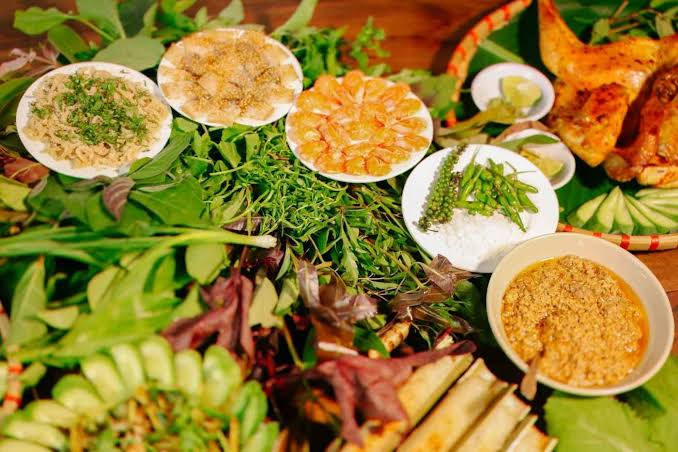
The tray arrives before the food does, and it is the food. Dozens of different leaves are laid out in rows — some familiar, most not, several gathered from the forest rather than grown — and you build each mouthful yourself. Goi la is the signature dish of the highland half of the new Quang Ngai, and it is less a salad than an argument that a meal can be made almost entirely of leaves. So how do you eat it?
What is on the tray
Counts vary by restaurant and by season, and forty is the number usually quoted. Some are common herbs, some are the leaves of fruit trees, and a good number are wild species that most Vietnamese diners will not recognise.
Alongside the leaves come boiled pork belly, small shrimp, rice noodles or steamed rice, salt, chilli and sliced ginger.
The dipping sauce is the other half of the dish: a thick, warm, savoury sauce that ties the whole thing together and differs from house to house.
Rice wine often appears alongside, and the meal is paced slowly because assembling each cone by hand takes time. This is a two-hour dinner, not a quick one.
How to build a mouthful
Take a large sturdy leaf as the base, layer two or three smaller ones on top, add a piece of pork, a shrimp, a grain or two of salt and a slice of ginger, then fold it into a cone and dip.
Do not try to include everything at once. The point is that each cone tastes different from the last, and a diner who mixes indiscriminately gets one flat flavour repeated forty times.
Vegetarians can eat most of the tray, though the sauce and the accompaniments usually contain seafood or pork. Ask before assuming.
What it tastes like
Bitter, sour, peppery, resinous, astringent — often several of these in one mouthful. Some leaves are startling on their own and make sense only in combination.
First-timers usually find one or two leaves genuinely unpleasant. That is normal, and locals will point out which ones to use sparingly if you ask.
Nothing on the tray is exotic for its own sake. Every leaf was eaten here long before it was served to visitors, and the restaurant version is a tidier arrangement of an everyday practice.
Where it comes from
The dish belongs to Kon Tum town and the surrounding highlands, where the plant knowledge behind it comes from communities who have gathered from this forest for generations.
It is not an ancient ceremonial dish; it is a local restaurant tradition built on that knowledge, and the restaurants that do it well are the ones with reliable foragers.
Ask the staff to name a few of the leaves as you go. Most will happily do it, and knowing what you are eating turns an unfamiliar tray into something you can navigate deliberately.
Practical notes
It is usually ordered for a group and priced per set rather than per person, so a solo traveller may find it difficult to order.
Availability follows the seasons. Fewer leaves appear on the tray in the dry months, and a good restaurant will tell you honestly rather than padding the tray.
Where it fits in a highland trip
Eat it in Kon Tum town, ideally on the evening you arrive from the coast, since it is the clearest possible signal that you have changed regions. Pair the visit with the wooden church the next morning, and continue up to Mang Den for cooler air. For grilled food over fire rather than leaves, see Mang Den grilled chicken and bamboo rice. Era Tourist books this as the first highland dinner — see the highland destination guide.
Cái mâm được bưng ra trước khi thức ăn tới, và chính nó là thức ăn. Hàng chục loại lá bày thành từng hàng — vài thứ quen, phần lớn thì không, nhiều loại hái từ rừng chứ không phải trồng — và bạn tự cuốn lấy từng miếng. Gỏi lá là món ký tên của nửa vùng cao thuộc Quảng Ngãi mới, và nó không hẳn là một món gỏi mà là một lập luận rằng có thể làm nên bữa ăn gần như hoàn toàn bằng lá. Vậy ăn thế nào?
Trên mâm có gì
Số lượng khác nhau tùy quán và tùy mùa, và con số hay được nhắc là bốn mươi. Có thứ là rau thơm quen thuộc, có thứ là lá cây ăn quả, và khá nhiều là loài mọc hoang mà phần lớn thực khách Việt không nhận ra.
Đi kèm với lá là thịt ba chỉ luộc, tôm nhỏ, bún hoặc cơm, muối hạt, ớt và gừng thái lát.
Chén nước chấm là nửa còn lại của món: một thứ nước sánh, ấm, đậm vị, buộc mọi thứ lại với nhau và mỗi nhà một khác.
Rượu cần thường xuất hiện cùng, và bữa ăn trôi chậm vì tự tay cuốn từng miếng rất mất thời gian. Đây là bữa tối hai tiếng chứ không phải bữa ăn nhanh.
Cuốn một miếng thế nào
Lấy một lá to và dai làm nền, xếp thêm hai ba lá nhỏ lên trên, đặt một miếng thịt, một con tôm, một hai hạt muối và một lát gừng, rồi cuộn thành hình phễu và chấm.
Đừng cố nhồi hết mọi thứ vào một lần. Cái hay là mỗi cuốn một vị khác cuốn trước, còn người trộn bừa thì nhận đúng một vị phẳng lặp lại bốn mươi lần.
Người ăn chay dùng được phần lớn mâm lá, dù nước chấm và đồ ăn kèm thường có hải sản hoặc thịt heo. Hãy hỏi trước chứ đừng mặc định.
Vị ra sao
Đắng, chua, cay, hăng nhựa, chát — thường vài thứ ấy cùng lúc trong một miếng. Có lá ăn riêng thì giật mình và chỉ có nghĩa khi đứng cạnh lá khác.
Người ăn lần đầu thường thấy một hai loại thật sự khó nuốt. Đó là chuyện bình thường, và nếu hỏi thì người bản địa sẽ chỉ cho bạn thứ nào nên dùng dè.
Không thứ gì trên mâm được bày ra để làm dáng lạ. Mọi loại lá đều đã được ăn ở đây từ rất lâu trước khi dọn cho khách, và bản nhà hàng chỉ là cách sắp xếp gọn gàng hơn của một nếp ăn thường ngày.
Món này từ đâu ra
Món thuộc về thị xã Kon Tum và vùng cao quanh đó, nơi vốn hiểu biết về cây cỏ đứng sau nó đến từ các cộng đồng đã hái lượm trong cánh rừng này qua nhiều đời.
Đây không phải món cúng tế cổ xưa; đó là một truyền thống quán ăn địa phương dựng trên vốn hiểu biết ấy, và quán nào làm hay là quán có người đi hái đáng tin cậy.
Hãy nhờ nhân viên gọi tên vài loại lá trong lúc ăn. Phần lớn đều sẵn lòng, và biết mình đang ăn gì sẽ biến một mâm lá xa lạ thành thứ bạn có thể chọn lựa có chủ đích.
Vài lưu ý thực tế
Món thường gọi cho cả nhóm và tính theo mâm chứ không theo đầu người, nên người đi một mình có thể thấy khó gọi.
Số lá theo mùa. Các tháng khô thì mâm ít loại hơn, và quán tử tế sẽ nói thật thay vì độn thêm cho đủ
Chỗ của nó trong chặng vùng cao
Hãy ăn ở thị xã Kon Tum, tốt nhất là ngay tối bạn từ biển lên, vì đó là tín hiệu rõ ràng nhất cho thấy bạn đã đổi vùng. Ghép với nhà thờ gỗ sáng hôm sau, rồi đi tiếp lên Măng Đen cho mát. Muốn đồ nướng trên lửa thay vì lá thì xem gà nướng Măng Đen và cơm lam. Era Tourist đặt món này làm bữa tối vùng cao đầu tiên — xem cẩm nang điểm đến vùng cao.