
Ask a Vietnamese person to quote a line of poetry and there is a fair chance it will come from a single book written by a man from this village. Nguyen Du was born into a scholarly family at Tien Dien in Ha Tinh, and the Tale of Kieu, the long narrative poem he wrote, occupies a place in Vietnamese culture that has no close equivalent elsewhere. The memorial here is quiet, modest and easy to underestimate. So what is worth understanding before you arrive?
Why this poem matters so much
The Tale of Kieu runs to more than three thousand lines and follows a woman who sacrifices herself for her family and endures years of misfortune before returning home.
Its hold is linguistic as much as narrative. Ordinary people quote it, argue with it, and use it for a form of divination, and phrases from it have passed into everyday speech in a way that almost no other literary work manages.
It was written in the vernacular script rather than classical Chinese, which is part of why it reached beyond the scholarly class and stayed there.
He served as an official under two dynasties and travelled to China on a diplomatic mission, and the poem draws on a Chinese source that he reworked entirely into Vietnamese.
What is at the site
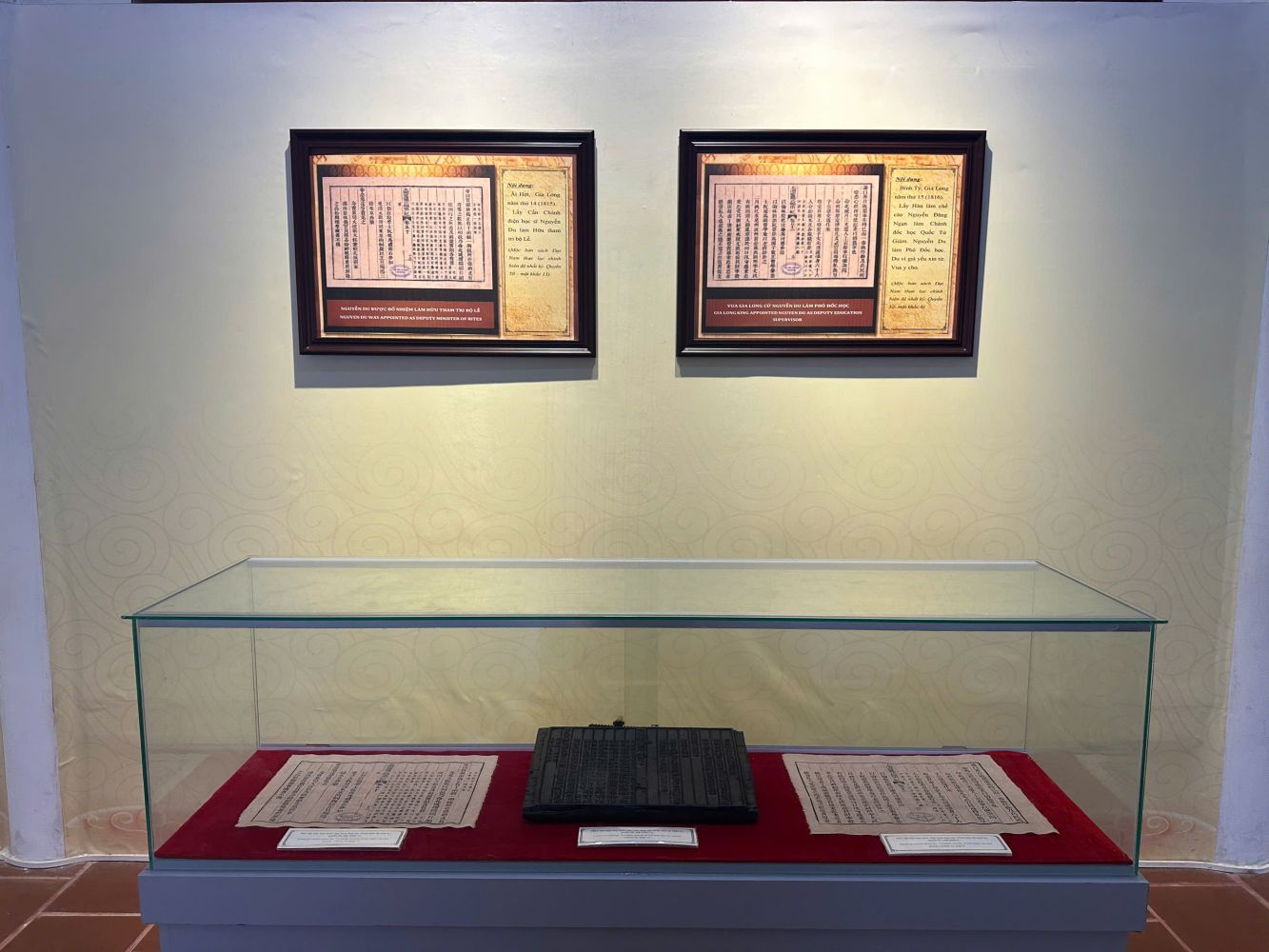
The memorial complex includes the ancestral hall of the Nguyen family of Tien Dien, an exhibition of manuscripts, editions and translations, the poet's grave, and old trees that predate most of the buildings.
The scale is domestic rather than monumental. This is a family compound turned into a memorial, and it reads as one.
The family produced scholars and officials across generations, and the compound was a centre of learning long before it was a memorial. That context is easy to miss and it explains the modest scale.
The exhibition
The collection of editions is the part worth slowing down for: printings in the old vernacular script, modern Vietnamese editions, and translations into dozens of languages.
Seeing the same poem in that many forms makes the point better than any commentary could. Ask the staff about the older woodblock printings if the subject interests you.
His grave lies within the grounds. It is unassuming, and most visitors find the plainness of it more affecting than the statuary elsewhere on the site.
How Vietnamese visitors treat it
School groups come constantly, and many adults arrive able to recite substantial sections from memory. It is a literary pilgrimage rather than a tourist stop.
Behave accordingly: quiet voices, incense at the grave if you wish, and no walking through a group that is being taught.
Anniversaries connected to the poet draw commemorative events and larger crowds. Outside those dates the site is usually very quiet.
Practical notes
The site is in Nghi Xuan, in the north of the province near the river boundary, and takes about an hour to see properly.
Interpretation in English is limited. Reading a summary of the poem before arriving changes the visit entirely, and without it the exhibition is difficult to engage with.
An hour is enough for the buildings, but the site rewards sitting under the old trees afterwards. Most people leave too quickly.
What to combine it with
Nghi Xuan is also the home of the ca tru singing tradition — see vi giam and ca tru — which makes this corner of the province unusually dense with cultural heritage. The scholarly village at Truong Luu belongs to the same tradition, and the mountain temple at Huong Tich is the landscape the poet grew up beneath. For gifts on the way out, see Ha Tinh Market. Era Tourist briefs the poem before this stop rather than at the gate.
Bảo một người Việt đọc một câu thơ, khả năng cao câu ấy nằm trong đúng một cuốn sách do người làng này viết ra. Nguyễn Du sinh trong một gia đình khoa bảng ở Tiên Điền, Hà Tĩnh, và Truyện Kiều, thiên truyện thơ ông viết, giữ một vị trí trong văn hóa Việt mà gần như không nơi nào có thứ tương đương. Khu lưu niệm ở đây lặng lẽ, khiêm nhường và rất dễ bị xem nhẹ. Vậy cần hiểu gì trước khi tới?
Vì sao thiên truyện ấy quan trọng đến vậy
Truyện Kiều dài hơn ba nghìn câu, kể về một người con gái bán mình chuộc cha rồi trải qua bao năm lưu lạc trước khi trở về.
Sức bám của nó nằm ở ngôn ngữ chẳng kém gì ở câu chuyện. Người bình dân thuộc Kiều, lẩy Kiều, bói Kiều, và nhiều lời trong đó đã đi thẳng vào tiếng nói hằng ngày theo cách gần như không tác phẩm văn học nào khác làm được.
Truyện được viết bằng chữ Nôm chứ không phải chữ Hán, và đó là một phần lý do nó vượt khỏi tầng lớp nho sĩ rồi ở lại đó luôn.
Ông từng làm quan dưới hai triều và đi sứ sang Trung Quốc, còn thiên truyện thì dựa trên một cốt truyện Trung Hoa mà ông viết lại hoàn toàn thành của người Việt.
Trong khu lưu niệm có gì
Quần thể gồm nhà thờ họ Nguyễn Tiên Điền, gian trưng bày các bản in và bản dịch, phần mộ thi hào, và những cây cổ thụ có tuổi hơn phần lớn công trình.
Quy mô mang tính gia tộc chứ không đồ sộ. Đây là một khuôn viên dòng họ được chuyển thành nơi lưu niệm, và nó hiện ra đúng như vậy.
Dòng họ này sinh ra nhiều đời khoa bảng và quan lại, và khuôn viên vốn là một trung tâm học vấn từ rất lâu trước khi thành nơi lưu niệm. Bối cảnh ấy rất dễ bị bỏ qua và nó giải thích cái quy mô khiêm nhường.
Gian trưng bày
Bộ sưu tập các bản in là phần đáng đi chậm nhất: bản in chữ Nôm xưa, các bản quốc ngữ hiện đại, và bản dịch ra hàng chục thứ tiếng.
Nhìn cùng một thiên truyện dưới ngần ấy hình hài nói lên nhiều hơn mọi lời bình. Nếu bạn quan tâm, hãy hỏi nhân viên về các bản khắc gỗ cổ.
Phần mộ thi hào nằm ngay trong khuôn viên. Ngôi mộ giản dị, và phần lớn người đến thăm thấy chính sự mộc mạc ấy thấm hơn các cụm tượng ở nơi khác trong khu.
Người Việt đến đây với tâm thế nào
Các đoàn học sinh về liên tục, và không ít người lớn tới nơi là đọc thuộc lòng được từng đoạn dài. Đây là một cuộc hành hương văn chương chứ không phải một điểm dừng du lịch.
Hãy cư xử tương xứng: nói khẽ, thắp hương ở phần mộ nếu muốn, và đừng đi cắt ngang một đoàn đang được giảng bài.
Các dịp kỷ niệm gắn với thi hào kéo theo hoạt động tưởng niệm và lượng khách lớn hơn. Ngoài những ngày đó, khu lưu niệm thường rất vắng.
Vài lưu ý thực tế
Khu lưu niệm thuộc Nghi Xuân, phía bắc tỉnh gần ranh giới sông, và xem cho tử tế mất chừng một tiếng.
Phần thuyết minh tiếng Anh khá hạn chế. Đọc tóm tắt thiên truyện trước khi tới sẽ đổi hẳn chuyến thăm, còn không thì gian trưng bày rất khó tiếp cận
Một tiếng là đủ cho các gian nhà, nhưng nơi này hậu đãi ai ngồi lại dưới tán cây cổ thụ sau đó. Phần lớn người ta rời đi quá nhanh.
Ghép với những gì
Nghi Xuân cũng là đất ca trù — xem ví giặm và ca trù — khiến góc này của tỉnh dày đặc di sản một cách hiếm thấy. Làng khoa bảng Trường Lưu thuộc cùng mạch truyền thống ấy, còn ngôi chùa núi Hương Tích là cảnh trí mà thi hào lớn lên bên dưới. Mua quà trên đường ra thì xem chợ Hà Tĩnh. Era Tourist thuyết minh thiên truyện trước điểm dừng này chứ không thuyết minh ở cổng.