
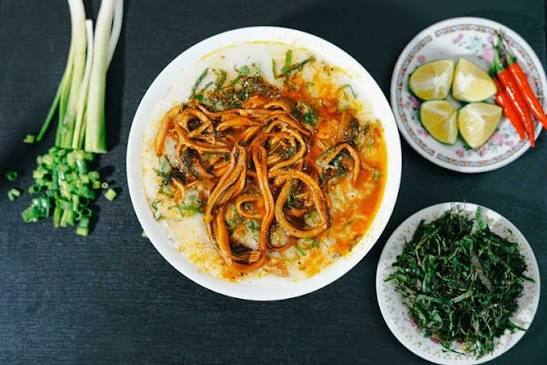
There is one ingredient that decides whether a bowl of Vinh eel porridge is the real thing, and it is not the eel. It is hanh tam, a tiny local allium the size of a marble, pungent and slightly bitter, which grows across the sandy soils of Nghe An and appears in almost nothing outside the province. Take it out and the bowl becomes generic eel porridge. Leave it in and you can taste which province you are in. So what else separates a good bowl here from an ordinary one?
The eel, and how it is handled
The eels are small paddy eels rather than farmed stock, and the traditional preparation matters: they are steamed or boiled first, then the flesh is stripped from the bone by hand along the length of the body.
The strips stay whole rather than being chopped, which is why the meat in a proper bowl reads as long golden ribbons rather than as fragments. Cooks here will tell you that metal blades bruise the flesh, and many still strip it using a sliver of bamboo.
Paddy eels are seasonal and smaller than farmed ones, with firmer flesh and a cleaner taste. Shops that use them do not advertise the fact, but the texture gives it away immediately.
Porridge or soup
Two dishes share the same eel and confuse every visitor. Chao luon is a porridge, thick with broken rice, eaten from a bowl on its own. Sup luon is a thinner soup with no rice, served to be eaten with steamed rice sheets — see banh muot with eel soup.
Order the porridge if you want one dish that stands alone. Order the soup if you want the fuller local breakfast.
Both are cooked from the same base, so a shop that does one badly will not do the other well. Judging a kitchen on a single bowl is fair here.
Turmeric, chilli and the colour of the bowl
A finished bowl arrives orange-gold, and the colour comes from turmeric and rendered fat carrying chilli rather than from tomato. The heat is present but not aggressive; the dominant note should be savoury and faintly bitter from the allium.
Fresh herbs go on at the table — Vietnamese coriander above all — along with black pepper and more chilli if you want it.
The bowl arrives properly hot, not warm, and it is meant to be eaten immediately — a Nghe An breakfast is a fast transaction, not a leisurely sit.
Eaten at breakfast, and rarely after
This is a morning dish. The best shops open early, cook one large pot, and stop when it is gone; a bowl offered at nine in the evening is a different proposition entirely.
Portions are modest and prices low, which is why locals treat it as a daily habit rather than a special meal.
Some shops offer a fried version of the eel, crisped in fat and served on top rather than stirred through. It is worth trying once, though the stripped version is the older habit.
What to look for in a shop
Look for eel stripped in long pieces, a broth that is cloudy from rice rather than thickened with starch, and a visible scatter of the small alliums. A bowl that arrives uniformly smooth and bright red has usually been simplified for speed.
Busy shops turn their pot over faster, which matters more here than the décor does.
Where to eat it and what follows
Vinh is the place for it, and a bowl before seven is the standard opening to a day that continues out to Kim Lien Village or west toward the mountains. For a shortlist of addresses, see our roundup of local specialty restaurants in Vinh. Era Tourist starts Nghe An itineraries with this bowl rather than a hotel buffet, because it is the fastest way to understand what the province tastes like — see the full day in our Vinh City destination guide.
Có một nguyên liệu quyết định tô cháo lươn Vinh có phải hàng thật hay không, và nó không phải con lươn. Đó là hành tăm, thứ củ nhỏ như hòn bi, hăng và hơi đắng, mọc khắp vùng đất cát Nghệ An và gần như không xuất hiện ở đâu ngoài tỉnh này. Bỏ nó ra, tô cháo thành cháo lươn chung chung. Để nó vào, bạn nếm được mình đang ở tỉnh nào. Vậy còn gì nữa tách một tô ngon khỏi một tô thường?
Con lươn và cách xử lý
Lươn dùng là lươn đồng nhỏ chứ không phải lươn nuôi, và cách sơ chế truyền thống mới là điều đáng nói: lươn được hấp hoặc luộc trước, rồi tuốt thịt khỏi xương bằng tay dọc theo thân.
Thịt giữ nguyên sợi dài chứ không băm nhỏ, vì thế trong tô đúng chuẩn, lươn hiện lên thành những dải vàng dài chứ không phải vụn thịt. Người nấu ở đây sẽ nói dao kim loại làm dập thớ thịt, và nhiều nhà đến nay vẫn tuốt bằng một mảnh cật tre.
Lươn đồng theo mùa và nhỏ hơn lươn nuôi, thịt chắc hơn và vị sạch hơn. Quán dùng lươn đồng không quảng cáo điều đó, nhưng cắn một miếng là biết ngay.
Cháo hay súp
Hai món dùng chung con lươn và làm mọi du khách bối rối. Cháo lươn là cháo, sánh gạo, ăn riêng một tô. Súp lươn loãng hơn, không có gạo, dọn ra để chấm cùng bánh mướt — xem bánh mướt súp lươn.
Gọi cháo nếu muốn một món đứng độc lập. Gọi súp nếu muốn bữa sáng bản địa đầy đủ hơn.
Cả hai món nấu từ cùng một nền, nên quán làm dở món này thì cũng không làm hay món kia. Đánh giá một cái bếp qua một tô là công bằng ở đây.
Nghệ, ớt và màu của tô cháo
Tô bưng ra có màu vàng cam, và màu ấy đến từ nghệ cùng lớp mỡ điều chứ không phải từ cà chua. Vị cay có nhưng không hung hăng; nốt chủ đạo phải là đậm đà và thoáng đắng của hành tăm.
Rau thơm cho vào tại bàn — trước hết là rau răm — cùng tiêu và thêm ớt nếu muốn.
Tô bưng ra phải nóng thật chứ không ấm, và ăn ngay — bữa sáng xứ Nghệ là một giao dịch nhanh chứ không phải buổi ngồi nhẩn nha.
Là món điểm tâm, hiếm khi ăn muộn
Đây là món buổi sáng. Quán ngon mở sớm, nấu một nồi lớn, hết là nghỉ; tô cháo mời lúc chín giờ tối là một câu chuyện hoàn toàn khác.
Phần vừa phải và giá rẻ, đó là lý do người địa phương xem nó là thói quen hằng ngày chứ không phải bữa đặc biệt.
Một số quán có thêm lươn xào giòn, chiên săn trong mỡ rồi rắc lên mặt thay vì trộn lẫn. Đáng thử một lần, dù kiểu tuốt sợi mới là nếp cũ.
Nhìn gì để chọn quán
Hãy tìm lươn tuốt sợi dài, nước cháo đục vì gạo chứ không phải sánh vì bột, và thấy rõ hành tăm rải trong tô. Tô nào bưng ra mịn đều và đỏ rực thường là đã được giản lược cho nhanh.
Quán đông thì nồi quay vòng nhanh hơn, và ở đây điều đó quan trọng hơn cách bài trí nhiều
Ăn ở đâu và sau đó đi đâu
Vinh là nơi để ăn món này, và một tô trước bảy giờ là cách mở màn chuẩn cho ngày đi tiếp ra Làng Sen Kim Liên hoặc ngược lên miền tây. Cần danh sách địa chỉ thì xem tuyển chọn quán đặc sản ở thành phố Vinh. Era Tourist mở đầu lịch trình Nghệ An bằng tô cháo này thay vì buffet khách sạn, vì đó là cách nhanh nhất để hiểu tỉnh này có vị gì — xem trọn ngày trong cẩm nang điểm đến thành phố Vinh.