
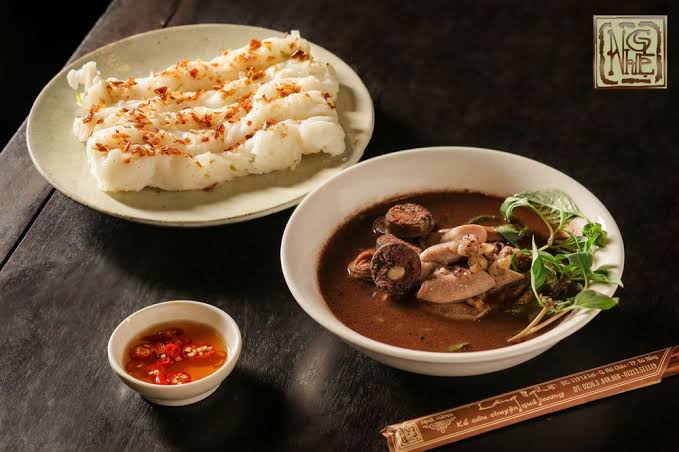
The sheets are made overnight and they are finished by lunchtime. Banh muot is a plain steamed rice roll, soft, faintly sweet and completely unfilled, and in Nghe An it is not eaten on its own — it is dipped into a bowl of eel soup that arrives at the same table. That pairing is the classic breakfast of this province, and getting it in the wrong order or the wrong combination is the usual visitor mistake. So how does it actually work?
What banh muot is, and is not
It looks like the rice rolls served elsewhere in Vietnam, but there is no pork filling, no wood ear mushroom and no fried shallot pressed inside. The sheet is steamed thin over cloth, rolled loosely while still hot, and served plain.
Its whole character is texture: soft, slippery, barely holding together. It is a vehicle, and the flavour is meant to come from the bowl beside it.
The batter is usually rice soaked and ground wet rather than mixed from flour, which is what gives the sheet its faint sweetness and its particular slip.
The soup it belongs with
The partner is sup luon — eel soup, thin and orange with turmeric, built on the same paddy eels and the same small local allium as Vinh eel porridge, but without rice in the bowl.
You dip the rolls, or tear them into the soup, or alternate mouthfuls. There is no fixed method, but the soup is never poured over the sheets — that turns them to paste within seconds.
A portion arrives as a small stack of rolls, often on a shared plate for the table, with the soup portioned individually. Ordering more rolls midway through is normal.
Why the timing is so strict
Rice sheets steamed at three in the morning are at their best within a few hours and stiffen noticeably by afternoon. Village makers deliver at dawn, shops sell through the morning, and what is left is not sold again the next day.
This is why banh muot is a breakfast in practice rather than by tradition. Buy it early, eat it the same morning, and do not carry it home as a souvenir.
Reheating does not rescue a stiff sheet. Steaming brings back some softness but never the original texture, which is why shops would rather sell out than hold stock.
Where it comes from
Whole villages in the coastal and midland districts make it, and the trade runs on family workshops rather than factories — one household steaming through the night for the shops of a whole neighbourhood.
Ask where the sheets came from and shopkeepers will usually name the village rather than a brand. That answer is a good sign.
Prices are among the lowest of any breakfast in the region, and the portions are sized on the assumption that you will order a second round if you want one.
Other ways it is eaten
Beyond the eel soup, the rolls are served with grilled pork sausage, with fermented pork, or simply with fish sauce, chilli and fried shallot. Some shops offer them alongside a bowl of clear broth instead.
All of these are legitimate, but the eel soup version is the one that belongs to this province specifically.
Eat the rolls warm rather than hot. Straight from the steamer they tear apart in the fingers, and a minute of resting is what makes them liftable.
Fitting it into a Nghe An morning
Have it at the start of a day heading out of the city — toward Kim Lien Village or the coast — and pick up dry goods later rather than earlier, since these sheets will not travel. For gifts that do travel, see Do Luong rice crackers. Era Tourist builds the first morning of a Nghe An trip around this table because it explains the province faster than any museum — see the full sequence in our Vinh City destination guide.
Bánh được tráng suốt đêm và bán hết trước trưa. Bánh mướt là lá bánh gạo hấp trơn, mềm, thoảng ngọt và hoàn toàn không nhân, và ở Nghệ An nó không ăn một mình — nó được chấm vào bát súp lươn dọn cùng bàn. Cặp đôi ấy là bữa sáng kinh điển của tỉnh này, và ăn sai thứ tự hoặc ghép sai món là lỗi thường gặp của khách phương xa. Vậy nó vận hành ra sao?
Bánh mướt là gì và không phải là gì
Nhìn thì giống bánh cuốn ở nơi khác, nhưng không có nhân thịt, không mộc nhĩ, không hành phi ép bên trong. Lá bánh được tráng mỏng trên vải, cuộn lỏng khi còn nóng, và dọn ra để trơn.
Toàn bộ tính cách của nó nằm ở kết cấu: mềm, trơn, chực bung ra. Nó là phương tiện, còn vị thì phải đến từ bát bên cạnh.
Bột thường là gạo ngâm rồi xay nước chứ không pha từ bột khô, và đó là thứ cho lá bánh vị ngọt thoảng cùng độ trơn đặc trưng.
Bát súp đi kèm
Bạn đồng hành là súp lươn — loãng, màu cam vì nghệ, nấu từ chính con lươn đồng và củ hành tăm như cháo lươn Vinh, nhưng trong bát không có gạo.
Bạn chấm bánh, hoặc xé bánh thả vào bát, hoặc ăn xen kẽ từng miếng. Không có phép tắc cố định, nhưng người ta không bao giờ chan súp lên bánh — làm vậy chỉ vài giây là bánh nát thành hồ.
Một suất bưng ra là một chồng bánh nhỏ, thường để đĩa chung cho cả bàn, còn súp thì chia từng bát riêng. Ăn giữa chừng gọi thêm bánh là chuyện bình thường.
Vì sao giờ giấc khắt khe đến thế
Lá bánh tráng lúc ba giờ sáng ngon nhất trong vài tiếng và cứng thấy rõ khi sang chiều. Lò làng giao lúc rạng đông, quán bán suốt buổi sáng, và phần thừa không được bán lại hôm sau.
Đó là lý do bánh mướt là món sáng trên thực tế chứ không phải theo lệ. Mua sớm, ăn ngay trong buổi sáng đó, và đừng mang về làm quà.
Hấp lại không cứu được lá bánh đã cứng. Hấp có mềm ra chút ít nhưng không bao giờ về được kết cấu ban đầu, nên các quán thà bán hết còn hơn giữ hàng tồn.
Bánh từ đâu ra
Cả những làng ven biển và vùng giữa làm nghề này, và nghề chạy bằng lò gia đình chứ không phải nhà máy — một nhà tráng suốt đêm cho các quán của cả một vùng.
Hỏi bánh lấy ở đâu, chủ quán thường nói tên làng chứ không nói tên hãng. Câu trả lời đó là dấu hiệu tốt.
Giá thuộc hàng rẻ nhất trong các món điểm tâm của vùng, và suất được định lượng với giả định rằng bạn sẽ gọi thêm nếu muốn.
Những cách ăn khác
Ngoài súp lươn, bánh mướt còn ăn với chả, với nem chua, hoặc chỉ với nước mắm, ớt và hành phi. Vài quán dọn kèm một bát nước dùng trong thay vì súp.
Cách nào cũng chính danh, nhưng bản ăn với súp lươn mới là bản thuộc riêng về tỉnh này
Hãy ăn bánh lúc ấm chứ đừng lúc còn bốc hơi. Vừa ra khỏi nồi, bánh đứt ngay trong tay; để nghỉ chừng một phút mới gắp lên được.
Xếp vào một buổi sáng xứ Nghệ
Hãy ăn vào đầu ngày rời thành phố — hướng Làng Sen Kim Liên hoặc ra biển — và để việc mua đồ khô lại sau chứ đừng mua trước, vì lá bánh này không đi đường được. Quà đi đường xa thì xem bánh đa Đô Lương. Era Tourist dựng buổi sáng đầu tiên của chuyến Nghệ An quanh cái bàn ăn này, vì nó giải thích tỉnh này nhanh hơn mọi bảo tàng — xem trình tự đầy đủ trong cẩm nang điểm đến thành phố Vinh.