
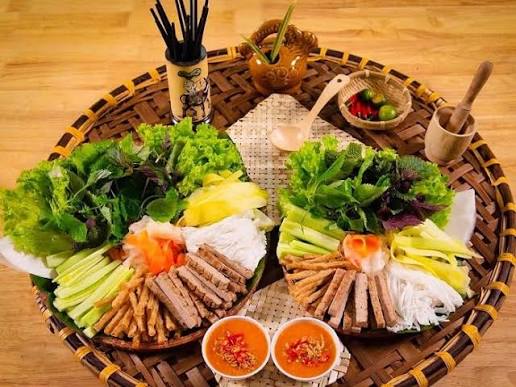
The meat is the easy part. Hue pork lemongrass skewer is judged almost entirely on the bowl of warm, thick sauce that comes beside it — and a stall that grills beautifully but pours a thin sauce will still be dismissed by locals. The skewers themselves are simple enough: seasoned pork paste moulded around a stalk of lemongrass and held over charcoal until the fat starts to catch. So why does everyone here talk about the sauce first?
What is on the stick
The paste is minced pork pounded with garlic, sugar, pepper and finely slivered pork skin, which is what gives the finished skewer its slight springiness rather than a crumbly texture. It is pressed by hand around the lemongrass and left to firm up before grilling.
The lemongrass is not a flavour gimmick and it is not eaten. As the stalk heats it releases oil into the meat from the inside while the charcoal works on the outside — one reason the skewer smells the way it does from three doors down.
Bamboo skewers are used at busier stalls, but the lemongrass version is the one worth seeking out, and vendors who still bother with it will say so before you ask.
The sauce is the exam
The dip, called nuoc leo, is built on pork liver and minced pork simmered with fermented soybean, then thickened and enriched with ground peanut and sesame. It arrives warm, opaque and thick enough to coat a roll rather than run off it.
Every household guards its own version, and the balance is difficult: too much liver turns it heavy and metallic, too little and it tastes like a peanut sauce from anywhere else in the country.
It is also served warm rather than hot, and never chilled — a cold nuoc leo seizes and separates, which is why it sits in a small pot over a low flame at the front of the stall.
You assemble it yourself
Nothing arrives pre-rolled. You get a stack of soft rice paper, a plate of greens, and the skewers still hot. Lay the paper down, add lettuce and herbs, a slice of green banana and a slice of fig, slide the meat off the stick, roll, dip.
The green banana and fig are not decoration — their astringency cuts the fat and stops the third roll tasting the same as the first. Skipping them is the most common visitor mistake.
How it differs from the versions elsewhere
Travelling south, the same dish appears with a thinner, sweeter dip and often pre-rolled for convenience. In Hue the sauce stays savoury and the assembly stays yours. If a plate arrives already rolled and the dip is runny and sweet, you are eating a coastal adaptation rather than the Hue original.
The other giveaway is the greens. A Hue plate always carries the astringent pair alongside the soft herbs; menus that reduce the plate to lettuce and cucumber have simplified the dish for speed.
When and where to eat it
Unlike the morning noodle bowls, this is an evening dish. Charcoal grills come out in the late afternoon and stalls run until the crowd thins. Prices are quoted per skewer, greens and rice paper come with the order, and a typical adult eats four to six.
Sit close to the grill if you can. Skewers lose their edge within a couple of minutes off the charcoal, and the difference between a fresh one and a rested one is larger here than with most grilled food.
Building it into a Hue evening
The natural order is monuments while the light is good, then grilled food once the heat drops. Pair it with a walk from Thuy Xuan Incense Village in the late afternoon, and keep the heavier bun bo for the next morning. Era Tourist schedules Hue evenings around the charcoal rather than the clock — see the full picture in our Hue destination guide, or run the day out to Thuan An and eat on the way back.
Phần thịt mới là phần dễ. Nem lụi Huế được chấm điểm gần như hoàn toàn ở chén nước lèo sánh nóng bên cạnh — quán nướng khéo đến mấy mà nước lèo loãng thì người Huế vẫn gạt đi. Bản thân que nem đơn giản: thịt heo quết gia vị, ốp quanh cây sả, hơ trên than tới lúc mỡ bắt lửa. Vậy vì sao ở đây ai cũng nói tới nước chấm trước?
Trên que có gì
Thịt heo quết với tỏi, đường, tiêu và da heo thái chỉ — chính da heo cho que nem độ giòn sần chứ không bở. Thịt được ốp bằng tay quanh cây sả rồi để nghỉ cho săn lại trước khi nướng.
Cây sả không phải chiêu trang trí và cũng không để ăn. Khi nóng lên, sả tiết tinh dầu vào thịt từ bên trong trong lúc than làm việc ở bên ngoài — lý do mùi nem lụi bay xa tới ba căn nhà.
Quán đông thường dùng que tre, nhưng bản ốp cây sả mới là bản đáng tìm, và những nơi còn chịu làm sả sẽ khoe trước khi bạn kịp hỏi.
Nước lèo mới là bài thi
Chén nước lèo dựng trên gan heo và thịt bằm rim cùng tương đậu, rồi làm sánh bằng đậu phộng và mè giã. Nó được bưng ra còn ấm, đục và đặc đủ để bám vào cuốn chứ không chảy tuột.
Mỗi nhà giữ công thức riêng, và cái khó nằm ở cân bằng: nhiều gan quá thì nặng và tanh, ít gan quá thì hóa ra chén sốt đậu phộng như mọi nơi khác.
Nước lèo cũng chỉ ấm chứ không nóng, và tuyệt đối không để nguội lạnh — nguội là nó đông và tách dầu, nên chén nước luôn đặt trên bếp lửa liu riu ngay đầu quán.
Bạn tự cuốn lấy
Không có gì được cuốn sẵn. Bàn dọn ra bánh tráng mềm, đĩa rau, và que nem còn nóng. Trải bánh, xếp xà lách và rau thơm, một lát chuối chát, một lát vả, tuốt thịt khỏi que, cuốn lại, chấm.
Chuối chát và vả không phải để trang trí — vị chát của chúng cắt béo và giữ cho cuốn thứ ba không giống hệt cuốn thứ nhất. Bỏ qua hai lát này là lỗi phổ biến nhất của khách.
Khác gì với phiên bản nơi khác
Càng đi về Nam, món này càng đi kèm chén chấm loãng và ngọt hơn, lại hay cuốn sẵn cho tiện. Ở Huế nước lèo giữ vị mặn đậm và việc cuốn vẫn là của bạn. Nếu đĩa bưng ra đã cuốn sẵn và nước chấm loãng ngọt, thì đó là bản duyên hải chứ không phải bản Huế.
Dấu hiệu thứ hai nằm ở đĩa rau. Đĩa rau Huế bao giờ cũng có cặp chát đi kèm rau thơm; nơi nào rút gọn còn xà lách với dưa leo là đã đơn giản hóa món cho nhanh.
Ăn khi nào, ở đâu
Khác các tô bún buổi sáng, đây là món của buổi tối. Lò than được dọn ra từ xế chiều và quán chạy tới khi vãn khách. Giá tính theo que, rau và bánh tráng đi kèm, một người lớn thường ăn bốn đến sáu que.
Ngồi gần lò được thì nên ngồi. Que nem xuống sức chỉ sau vài phút rời than, và khoảng cách giữa que vừa ra lò với que để nguội ở đây lớn hơn hầu hết món nướng khác.
Xếp vào một buổi tối ở Huế
Trình tự tự nhiên là đi di tích lúc trời còn sáng, rồi ăn đồ nướng khi nắng đã hạ. Ghép với buổi chiều dạo làng hương Thủy Xuân, còn tô bún bò nặng bụng thì để sáng hôm sau. Era Tourist xếp buổi tối ở Huế theo bếp than chứ không theo đồng hồ — xem toàn cảnh tại cẩm nang điểm đến Huế, hoặc chạy ra Thuận An rồi ăn trên đường về.