
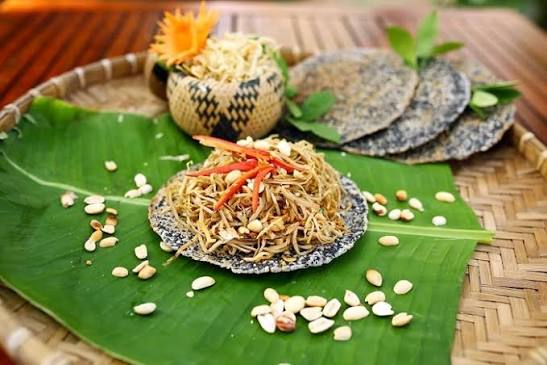
There is a couplet every child in the province can finish: nhut from Thanh Chuong, soy sauce from Nam Dan. Nhut Thanh Chuong is shredded unripe jackfruit packed with salt and left to sour in a stoneware jar, and it began as what poor households ate when there was nothing else. Today it is the dish Nghe An uses to identify itself. So how did a preserved vegetable become a provincial emblem, and what does it actually taste like?
What goes into the jar
Young jackfruit is peeled, the core removed, and the flesh shredded fine while still firm. It is salted heavily, pressed down under a weight in a jar, and left to ferment for several days until it turns pale and sour.
Some households add ginger, chilli, galangal or lemongrass. The base recipe is jackfruit and salt, and everything beyond that is a family signature.
The fruit has to be genuinely young — firm, white, with seeds not yet formed. A jackfruit even slightly on the way to ripe turns sweet in the jar and the whole batch is wrong.
The step that decides everything
Unripe jackfruit bleeds a sticky white latex that ruins both the knife and the flavour. Cooks here work with an oiled blade and a bowl of water at hand, dropping the shredded flesh straight into the water to rinse the sap away.
Get that wrong and the finished nhut is bitter and glue-like. It is the reason a bought jar from a household that has made it for decades tastes cleaner than a first attempt at home.
Timing matters at the other end too. Left too long the shreds go soft and the sourness turns flat, so households eat through a jar rather than storing it indefinitely.
What it tastes like, and how it is eaten
Sour, salty, faintly bitter, with a fibrous crunch that survives cooking. It is not a salad and it is not a pickle in the European sense — it is closer to sauerkraut in function, a sharp counterweight to plain rice and fatty meat.
The three standard uses are straight from the jar as a side, stir-fried with pork, and simmered into a sour soup with river fish. The soup is the version most visitors underestimate.
First-timers usually find it sharp. Try it stir-fried before eating it plain, since the fat and heat round off the sourness and make the texture easier to read.
Why Thanh Chuong
Thanh Chuong is a midland district west of Vinh, on the road toward the mountains, where jackfruit grows across the hill gardens. The dish is a straightforward answer to a hard climate: a summer glut of unripe fruit turned into food that lasts through months when little else does.
That origin is not hidden here. People describe nhut as poor-country food and say it with pride rather than apology.
Buying a jar to take home
It travels well, which is unusual among the province's specialities. Look for shreds that are still distinct rather than mushy, liquid that is cloudy rather than slimy, and a smell that is sharp and clean.
Sealed jars from established households are sold in markets across the province; ask for a recent batch rather than the oldest one on the shelf.
Where it fits on the table
Nhut is a counterweight, not a centrepiece. It belongs beside rich dishes, which is why a Nghe An table often sets it next to grilled or braised pork and a bowl of plain rice. The other half of the couplet, Nam Dan soy sauce, usually sits on the same table. You will pass Thanh Chuong on the drive to Pu Mat National Park, which makes it an easy stop, and jars are sold at Vinh Market if you would rather buy in the city. Era Tourist builds a market stop into the western leg for exactly this — see our Vinh City destination guide.
Có một câu mà đứa trẻ nào trong tỉnh cũng đọc nốt được: nhút Thanh Chương, tương Nam Đàn. Nhút Thanh Chương là mít non thái sợi, muối mặn rồi ủ chua trong vại sành, và nó khởi đầu là thứ nhà nghèo ăn khi chẳng còn gì khác. Ngày nay nó là món mà Nghệ An dùng để tự giới thiệu mình. Vậy một món muối chua thành biểu tượng của cả tỉnh bằng cách nào, và nó có vị gì?
Trong vại có gì
Mít non gọt vỏ, bỏ cùi, xắt sợi nhỏ khi còn cứng. Muối mặn tay, nén vật nặng lên trong vại, ủ vài ngày cho tới khi ngả trắng và chua.
Có nhà cho thêm gừng, ớt, riềng hoặc sả. Công thức gốc chỉ có mít và muối, mọi thứ ngoài đó là chữ ký riêng của từng nhà.
Quả phải thật non — chắc, trắng, hạt chưa kịp hình thành. Trái mít chỉ hơi ngả già một chút là vào vại sẽ ngọt, và cả mẻ coi như hỏng.
Khâu quyết định tất cả
Mít non chảy mủ trắng dính, làm hỏng cả con dao lẫn mẻ nhút. Người làm ở đây bôi dầu lên lưỡi dao và để sẵn một thau nước, thái tới đâu thả sợi vào nước tới đó cho trôi mủ.
Sai khâu này thì nhút vừa đắng vừa nhớt. Đó là lý do một hũ mua từ nhà làm nghề mấy chục năm bao giờ cũng sạch vị hơn mẻ tự làm lần đầu.
Đầu bên kia cũng phải canh. Để lâu quá thì sợi nhũn và vị chua bệt lại, nên nhà nào cũng ăn hết vại chứ không trữ vô hạn.
Vị ra sao và ăn thế nào
Chua, mặn, thoảng đắng, và giòn xơ theo kiểu chịu được lửa. Nó không phải nộm, cũng không phải dưa muối kiểu Âu — về chức năng nó gần với dưa cải bắp lên men: một đối trọng sắc để cân lại cơm trắng và thịt béo.
Ba cách dùng chuẩn là ăn sống ngay từ vại, xào với thịt ba chỉ, và nấu canh chua với cá sông. Bát canh mới là bản mà khách phương xa hay đánh giá thấp.
Người ăn lần đầu thường thấy gắt. Hãy thử bản xào trước khi ăn sống, vì mỡ và lửa làm tròn vị chua lại và giúp cảm nhận kết cấu dễ hơn.
Vì sao lại là Thanh Chương
Thanh Chương là huyện trung du phía tây Vinh, trên đường ngược lên núi, nơi mít mọc khắp vườn đồi. Món này là câu trả lời thẳng thắn cho một khí hậu khắc nghiệt: một mùa mít non ê hề được biến thành thức ăn giữ được qua những tháng gần như không có gì khác.
Gốc gác ấy không bị giấu đi. Người ta gọi nhút là món nhà nghèo, và nói bằng giọng tự hào chứ không phải giọng thanh minh.
Mua một hũ mang về
Nhút đi đường tốt, điều hiếm thấy trong các đặc sản của tỉnh. Hãy chọn hũ còn thấy rõ từng sợi chứ không nhũn, nước đục chứ không nhớt, và mùi phải gắt mà sạch.
Hũ đóng kín của các nhà làm nghề lâu năm được bán ở chợ khắp tỉnh; hãy hỏi mẻ mới thay vì lấy hũ nằm lâu nhất trên kệ
Chỗ của nó trên mâm cơm
Nhút là đối trọng chứ không phải món chính. Nó nằm cạnh những món béo, nên mâm cơm xứ Nghệ hay đặt nó bên đĩa thịt kho hoặc thịt nướng và bát cơm trắng. Nửa còn lại của câu ca, tương Nam Đàn, thường có mặt trên cùng cái mâm ấy. Bạn sẽ đi ngang Thanh Chương trên đường lên Vườn quốc gia Pù Mát, nên ghé rất tiện, còn muốn mua trong thành phố thì có ở chợ Vinh. Era Tourist cài sẵn một điểm dừng chợ vào chặng miền tây đúng vì việc này — xem cẩm nang điểm đến thành phố Vinh.