
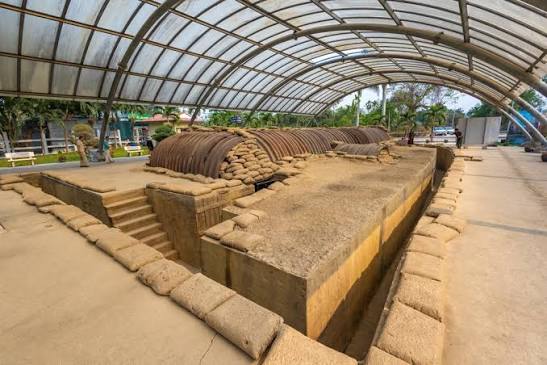
At the very heart of the old French base lies De Castries Bunker, the preserved command post where the historic Battle of Dien Bien Phu finally came to its dramatic end in 1954. This was the headquarters of the French commander, General de Castries, and it was here that he and his staff were captured, marking the decisive conclusion of one of the twentieth century's most important battles. The bunker survives much as it was, a low, sandbagged structure that draws visitors from across the country. So what exactly makes De Castries Bunker such a significant and evocative place to visit?
The nerve centre of the French base
De Castries Bunker served as the central command post of the entire French entrenched camp at Dien Bien Phu, the nerve centre from which the French commander directed the defence of the whole fortified valley.
Its position at the very heart of the base made it the ultimate objective of the Vietnamese campaign, and it is precisely this role as the command centre of the French forces that gives De Castries Bunker its profound historical importance.
Where the battle was decided
It was here, in this very bunker, that the battle reached its climax when Vietnamese forces overran the position and captured General de Castries and his staff, bringing the long and costly campaign to a decisive close.
This moment marked one of the most significant turning points in modern history, and understanding that the war's fate was sealed in this modest structure is central to appreciating the deep meaning of a visit to De Castries Bunker.
The preserved structure
The bunker itself survives today as a low, heavily reinforced structure protected by layers of sandbags and corrugated metal sheeting, carefully preserved to show visitors the cramped, dim and purely functional conditions from which the French high command operated throughout the long siege.
Being able to actually see and step inside this genuine, surviving wartime structure gives a remarkably vivid and tangible sense of the harsh reality of the battle, and it is precisely this raw authenticity that makes a visit to De Castries Bunker so very much more powerful and affecting than any mere written description ever could be.
Relics of the campaign
Around the bunker, the site preserves elements of the old fortifications and wartime relics, helping visitors picture how this command post sat at the centre of a vast and heavily defended entrenched camp.
These various surviving features add genuinely valuable context and depth to a visit, and together they help the preserved De Castries Bunker to tell the fuller and richer story of the elaborate French defensive system across the valley and its ultimate, decisive collapse in the face of the determined Vietnamese assault.
A site of national memory
For Vietnamese visitors, De Castries Bunker is a place of great national pride and memory, a tangible symbol of a hard-won victory that resonated far beyond Vietnam and helped reshape the course of history.
Approaching the site with respect and an understanding of its significance greatly enriches a visit, and experiencing De Castries Bunker as a symbol of national memory is key to grasping its true importance.
Why it belongs on your itinerary
Historic, deeply evocative and utterly central to the dramatic conclusion of the whole Dien Bien Phu campaign, De Castries Bunker offers a genuinely tangible and moving connection to the decisive final moments of one of the twentieth century's truly great and history-changing battles.
For any traveller wishing to understand this pivotal chapter of history, a visit to De Castries Bunker is among the most meaningful and memorable experiences that the whole of Dien Bien has to offer.
Era Tourist's arrangement: we suggest visiting the historic De Castries Bunker as part of a full day exploring the preserved battlefield of the valley using our Dien Bien travel guide, ideally combined with an unhurried climb up the famous and deeply moving nearby A1 Hill so as to complete the fuller picture of the decisive campaign.
Ngay tại trung tâm căn cứ Pháp cũ là hầm Đờ Cát, sở chỉ huy được bảo tồn nơi trận Điện Biên Phủ lịch sử cuối cùng đi đến hồi kết kịch tính năm 1954. Đây là tổng hành dinh của viên tướng Pháp de Castries, và chính tại đây ông cùng bộ tham mưu bị bắt sống, đánh dấu sự kết thúc quyết định của một trong những trận đánh quan trọng nhất thế kỷ hai mươi. Căn hầm còn tồn tại gần như nguyên trạng, một công trình thấp, đắp bao cát thu hút du khách từ khắp cả nước. Vậy điều gì khiến hầm Đờ Cát thành một nơi ý nghĩa và gợi cảm để viếng thăm?
Trung tâm đầu não của căn cứ Pháp
Hầm Đờ Cát là sở chỉ huy trung tâm của toàn bộ tập đoàn cứ điểm Pháp tại Điện Biên Phủ, trung tâm đầu não từ đó viên tướng Pháp chỉ huy việc phòng thủ cả thung lũng kiên cố.
Vị trí ngay trung tâm căn cứ khiến nó thành mục tiêu tối hậu của chiến dịch Việt Nam, và chính vai trò như trung tâm chỉ huy của quân Pháp ấy mang cho hầm Đờ Cát tầm quan trọng lịch sử sâu sắc.
Nơi trận đánh được định đoạt
Chính tại đây, trong căn hầm này, trận đánh lên đến đỉnh điểm khi quân đội Việt Nam tràn ngập cứ điểm và bắt sống tướng de Castries cùng bộ tham mưu, đưa chiến dịch dài và tổn thất đến một kết thúc quyết định.
Khoảnh khắc ấy đánh dấu một trong những bước ngoặt quan trọng nhất lịch sử hiện đại, và hiểu rằng số phận cuộc chiến được định đoạt trong công trình khiêm nhường này là điều cốt yếu để trân trọng ý nghĩa sâu xa của chuyến viếng hầm Đờ Cát.
Công trình được bảo tồn
Bản thân căn hầm còn tồn tại như một công trình thấp, gia cố được bảo vệ bằng bao cát và tôn múi, được bảo tồn để cho du khách thấy điều kiện chật chội, thực dụng mà bộ chỉ huy Pháp đã hoạt động trong suốt cuộc vây hãm.
Việc có thể nhìn thấy và bước vào công trình thời chiến đích thực ấy mang đến một cảm nhận sống động, hữu hình về thực tế trận đánh, và chính sự chân thực ấy khiến hầm Đờ Cát mạnh mẽ hơn nhiều bất kỳ lời mô tả nào.
Di vật của chiến dịch
Quanh căn hầm, di tích bảo tồn những phần của công sự cũ và di vật thời chiến, giúp du khách hình dung sở chỉ huy này đã nằm ở trung tâm một tập đoàn cứ điểm rộng lớn, phòng thủ dày đặc ra sao.
Những đặc điểm còn sót lại ấy thêm bối cảnh quý giá cho chuyến thăm, và cùng nhau chúng giúp hầm Đờ Cát kể câu chuyện đầy đủ hơn về hệ thống phòng thủ Pháp và sự sụp đổ tối hậu của nó trước cuộc tấn công của Việt Nam.
Một di tích của ký ức dân tộc
Với du khách Việt, hầm Đờ Cát là một nơi của niềm tự hào và ký ức dân tộc lớn lao, một biểu tượng hữu hình của một chiến thắng gian nan mà tiếng vang vượt xa khỏi Việt Nam và góp phần định hình lại dòng chảy lịch sử.
Tiếp cận di tích với sự tôn trọng và hiểu biết về ý nghĩa của nó làm giàu thêm rất nhiều cho chuyến thăm, và cảm nhận hầm Đờ Cát như một biểu tượng của ký ức dân tộc là chìa khóa để nắm bắt tầm quan trọng thật sự của nó.
Vì sao nên có trong lịch trình
Giàu lịch sử, gợi cảm và cốt yếu với hồi kết của chiến dịch Điện Biên Phủ, hầm Đờ Cát mang đến một kết nối hữu hình và xúc động với những khoảnh khắc cuối cùng quyết định của một trong những trận đánh lớn của lịch sử.
Với bất kỳ du khách nào muốn hiểu chương lịch sử then chốt này, một chuyến viếng hầm Đờ Cát nằm trong số những trải nghiệm ý nghĩa và khó quên nhất mà cả Điện Biên có thể trao tặng.
Gợi ý sắp xếp của Era Tourist: chúng tôi gợi ý viếng hầm Đờ Cát như một phần của ngày khám phá chiến trường lịch sử theo cẩm nang du lịch Điện Biên, lý tưởng nhất là kết hợp một chặng leo lên đồi A1 trứ danh gần đó để trọn vẹn bức tranh chiến dịch.